Verdict
A bold and smart upgrade, Amazon Alexa+ is the update the system needed. Powered by GenAI, Alexa+ has been built and fine-tuned to understand natural language. Able to search out answers, the system can’t respond or understand in a few instances, making it useful for day-to-day life. Its local business search is poor, and the lack of support for work calendars is frustrating, but things will improve. For now, the excellent smart home control, ability to learn more about you, and the tools to disseminate information from emails, PDFs and photos make this the best smart assistant for the home.
Somewhere along the line Alexa lost a bit of its magic. When it launched, over ten years ago, there was nothing like. It felt as though the future had finally arrived. But, over time, the limitations came out: Alexa couldn’t do everything, and it often needed commands to be phrased in a specific way (Alexa speak, as it’s come to be known).
Now, there’s the new version, the GenAI-powered Alexa+, which is finally available in the UK. A conversational upgrade, Alexa+ has got be back into using voice, asking questions, controlling my smart home and more. It’s not perfect, but as home assistants go, it’s the best by a long way.
Alexa+ is currently available in Early Access, which means it’s free, but you also need an invite to use it. The fastest way to get access is to buy a new smart speaker, such as the Echo Show 11, although you can register your interest online and wait for the invite.
Eventually, Alexa+ will have a price: £19.99/$19.99 per month, though you get it bundled with Amazon Prime.
Before I get into it, it’s worth noting that Alexa+ is different depending on which part of the world you live in. Rather than a standard voice assistant, Alexa+ is built to understand regional differences and respond appropriately. Here in the UK, that meant that Amazon had to do quite a lot of work, teaching Alexa+ how to understand and respond to lots of regional accents.
What remains the same across countries is that Alexa+ no longer needs Alexa Speak to work. Instead, you speak in a normal way, as though talking to a human (or typing to ChatGPT).
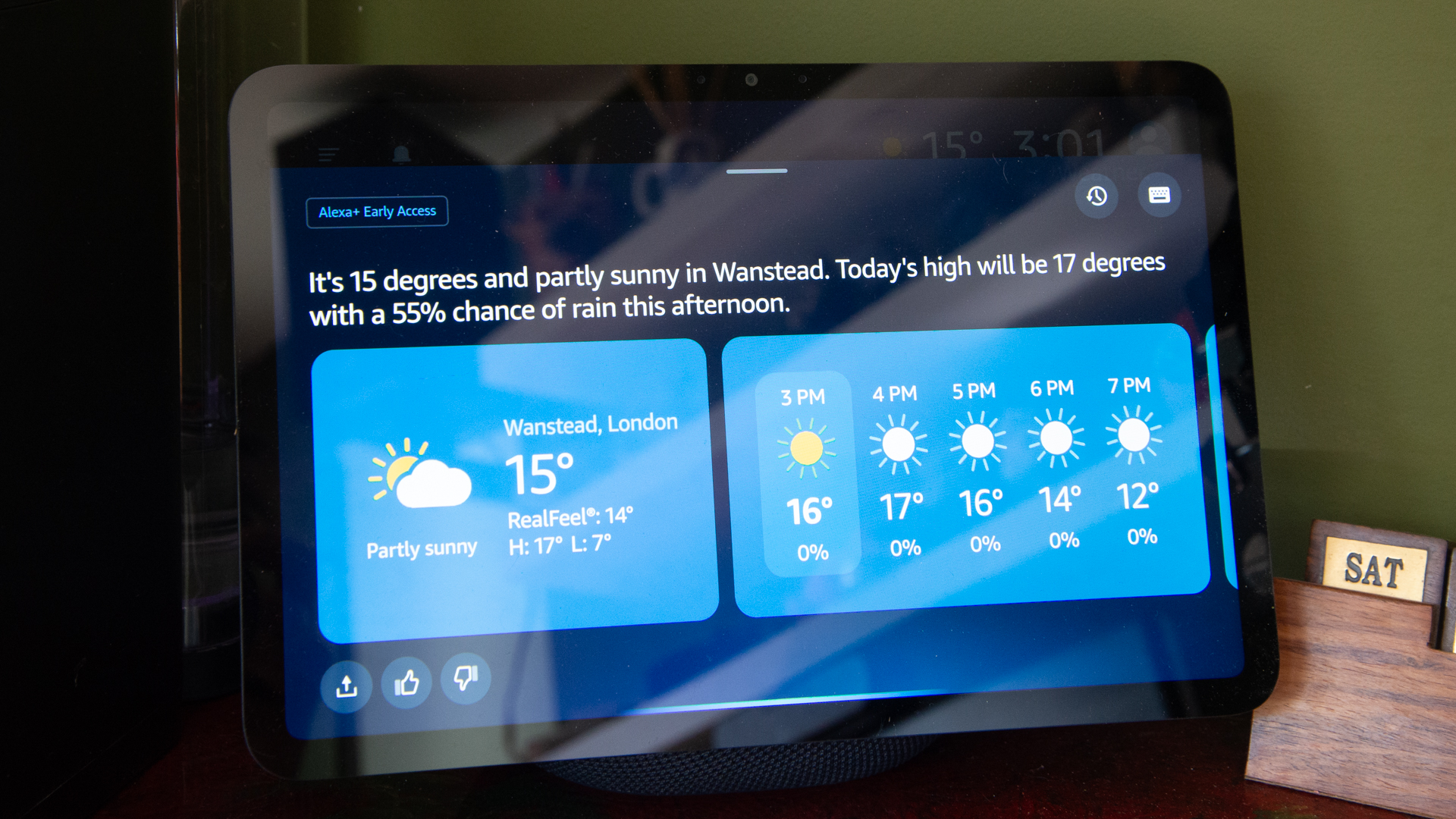
So, you can still say, “Alexa, weather” to get a basic overview of the weather in your location, but you can also ask, “When’s a good day to have a BBQ?” or “Will the weather be consistently nice this week?”
Alexa+ understands what you’re asking and responds in a proper way, giving a sensible answer to your questions. There are few times that Alexa+ will say that it can’t understand, but if it does, you can just rephrase your question; again, it’s like talking to a real person.
More importantly, Alexa+ gets context, both in the short-term and the long-term. For example, you can follow up with a question to your last request at any point, and Alexa+ will respond without you having to repeat everything.
But, over time, Alexa+ can build up information about you, your family and friends. It does this both directly (when you first enrol Alexa+ you have to select some preferences, such as favourite music), and by learning based on what you ask. And, you can also specifically tell Alexa+ information, such as “Alexa, I’m a Spurs fan” or “Alexa, my wife’s a vegetarian”.
This information is used by Alexa+, with it tweaking its responses. Following up on the vegetarian information, if I ask Alexa+ to recommend some chicken dishes for me and my wife, it comes back and reminds me that my wife doesn’t eat chicken and suggests vegetarian recipes instead.
Trying the same thing for Gemini for Home results in a complete failure, and lots of chicken dish recipes.
Alexa+ can also modulate its emotional response. Asking about the football results, Alexa+ has mostly had to adopt a sad tone for Spurs, although a recent win was reported with a more excited and happy tone.
Alexa+ is also much better at retrieving information from the internet, answering almost any question you can think of. For example, it could tell me what the song is at the end of Fight Club (The Pixies, Where Is My Mind?); it could tell me if the recent tube strikes were going ahead or not, and when they’d start and stop; and it could tell me who won the best original score Oscar in 2003 (Elliot Goldenthal for Frida).
It’s impressive, and when you want to know something quickly, Alexa+ is often a better route to go down, rather than pulling out a phone and getting caught in doomscrolling.
While Alexa+ is good at retrieving information, its default responses often verge on the annoying. The voice assistant has been programmed to be a little too chirpy, too verbose and overly friendly.
Asking about the tube strikes, the initial response was way too excited. Talking about football, Alexa+ kept calling me “mate” a lot. In general, Alexa+ will talk a lot, rather than giving simple replies.
However, Alexa+ is built to learn. Tell it that you don’t like being called mate or that you prefer shorter answers, and Alexa+ will remember. The more you use it, the better suited to you it becomes.
Well, mostly. There are still things that can go wrong, but that are getting better. On my Echo Show, when I ask about Spurs, Alexa+ responds with information on the football club, but it shows shortcuts to more information on the San Antonio Spurs, which wasn’t very useful. However, this has since been fixed, and I get correct information.
Another area that Alexa+ massively needs to improve is with its local business information. This is horribly out-of-date and not useful. I asked for the nearest French restaurant and got a recommendation for one that shut in 2023, while the better option wasn’t listed at all.
There can also be a mismatch between what Alexa+ says and what information it displays on an Echo Show. With that French restaurant, Alexa+ told me it was open between 5pm and 9pm, but the snippet on the screen from TripAdvisor showed that the restaurant was closed (it said today, but really it’s forever).
Restaurants on OpenTable can be booked using voice, with a simple command: the date, time and number of people; or you can even say find a slot in your diary on a certain day, and Alexa+ will do the hard work of finding and booking for you.
It’s cool when it works, but you’re limited to restaurants that don’t require card information (Amazon is working on this).
If Amazon can spend some money to update its live local listings, it will get even better.
Alexa+ can be linked to your email and calendars, helping you manage them. Provided you don’t pay to have Google or Microsoft email, as these accounts are currently not supported, which is a bit frustrating. For now, then, free accounts are supported.
As noted above, calendar information can be used for things like finding a time to go to a restaurant. But, you can also get Alexa+ to add appointments. Ask when your team’s playing next, for example, and Alexa+ can add a calendar reminder for you.
Things get really clever when you add in Alexa+’s ability to understand structured data from documents. You can either email Alexa+, use the app to upload documents or even take a photo of something.
I sent a PDF of my daughter’s DofE information, and a couple of minutes later the app pinged me with some to-do list items (things to get and bring), and calendar entries for the various training days and expeditions.
I used my camera to take a photo of the school’s horribly structured term dates page, and Alexa+ pulled out school holidays and inset days in an instant. That can be a real time saver.
Alexa+ will also store and remember documents for you. I sent over a PDF instruction manual for my dishwasher, and then could quiz Alexa+ about it, such as asking what an error code meant or where the salt goes. The same goes for game instructions, too.
Alexa+ can do everything the old system can do and more. Natural language makes a big difference.
If you’re cold, rather than asking for the current temperature in your room and then asking again to set the temperature to something above this, I can just say, “Alexa, it’s cold in here” and the heating gets turned up.
Routines can be made more easily, too. They can be permanent, say turning a light on and off at a certain time every day, or they can be temporary: “Alexa, turn the heating off in 10 minutes’ time.”
You can also chain commands for a one-time run, such as turning the lights on, waiting 10 minutes, then turning them off again. In reality, though, these can go wrong.
“Alexa, set Dave’s office heater to 25° and then after five minutes turn it off,” I said. Alexa created a routine that matched my description, but the trigger was the full, long phrase I’d used. That was not what I wanted.
But, Alexa+ is learning and improving all of the time, and what it generally does what I want a good 90%+ of the time, even with complicated commands.
Alexa+ is a big step up from standard Alexa. Easier to talk to and smarter, its responses (once tweaked to suit preferences) feel more natural, and its ability to learn and understand wider contexts means that it gets better the more you use it. Local search is currently poor, and the lack of support for work calendars annoying, but these will get better, and for now the excellent smart home support and ability to disseminate information from PDFs, photos and emails makes this the best smart assistant.
When we publish our reviews, you can rest assured that they are the result of “living with” long term tests.
Smart assistants usually live within an ecosystem, or a range of products that – supposedly – all work in harmony. And they are designed to offer a range of different options. Therefore, it’s impossible to use a smart assistant for weeks and deliver a verdict.
Because we’re testing smart home kit all day, everyday, we know what matters and how a particular smart cleaning machine compares to alternatives that you might also be considering.
Our reviews are comprehensive, objective and fair and, of course, we are never paid directly to review a device.