When users purchase VoxMeta H1 Pro, they are not only getting an industrial-grade 3D scanner, but also precise, usable industrial-grade 3D data. Just like the well-known saying, users do not want to buy a quarter-inch drill; they want a quarter-inch hole. For industrial teams, what truly matters is not how advanced the scanner looks, nor how impressive the parameter sheet appears, but whether the final scan data is accurate, whether the STL can be used, and whether the model can enter the next workflow.
This is also the starting point for understanding industrial 3D scanning. The scanner is only a tool. The scan result is what users truly need. The value of a 3D scanner eventually comes down to one practical question: can it help teams obtain reliable 3D data faster and use that data for reverse engineering, dimensional inspection, CAD comparison, and production decisions?
The product logic of VoxMeta H1 Pro is built around this result. It is not only designed to let users “scan something.” It is designed to help users obtain usable, accurate, and stable industrial-grade 3D data faster. When the scan result can directly serve real projects, the scanner truly changes from a device into a production capability that teams can use repeatedly.
Users Are Not Buying a Scanner, but Usable Industrial Data
In industrial sites, very few people scan simply because they want to “own a scanner.” When engineers pick up a scanner, it is usually because there is already a clear task in front of them: reproducing an old part, checking machining deviation, comparing with a CAD model, or quickly turning a physical object into a digital file. Scanning is only the middle step. The final goal is to obtain data that can continue to be used.
Therefore, industrial 3D scanning cannot be judged only by the device itself. What users truly need to focus on is data quality, data completeness, and data stability. If the scanned STL loses details, has blurred edges, deformed hole positions, or incomplete curved surfaces, then no matter how good the device parameters look, it will still be difficult to use with confidence in real projects.
VoxMeta H1 Pro 3D scanner is aimed at the 3D data that industrial users truly need. For real industrial projects, whether the result is usable is more important than simply describing device performance.
Whether the STL Can Be Used Is the First Standard of Scanning Value
For many industrial users, the final result they deal with is not a list of parameters, but an STL, OBJ, point cloud file, or a data model imported into reverse engineering software or inspection software. Whether this file can be used is the first standard for judging whether the scanning task is successful.
A usable STL cannot only look like the original part on the outside. It also needs complete surface information, clear structural boundaries, stable curved surface details, and credible dimensional performance. For machined parts, molds, fixtures, and automotive components, if the scan result only “looks similar,” it is still not enough to support the next engineering workflow.
This is also why H1 Pro emphasizes metrology-grade capability. H1 Pro can reach up to 0.015 mm accuracy, with the goal of helping users obtain more reliable industrial-grade scan results. This accuracy is not only for making the parameter page look better, but for allowing the final data to support the next stage of work.
Accuracy Is the Baseline of the Next Workflow
In industrial 3D scanning, accuracy is not an isolated metric. If the scan data has obvious deviation, reverse modeling may move away from the original part. If key dimensions are not reliable, inspection decisions are difficult to establish. If point cloud stability is insufficient, later meshing and CAD comparison will also be affected.
Therefore, industrial users do not need a number that only looks good in theory. They need the ability to obtain stable results under real parts, real surfaces, and real operating conditions. The final test of a scanner is not on the promotional page, but in the software, in the project, and in the judgment of engineers.
VoxMeta H1 Pro combines high accuracy, blue laser scanning, and stable data acquisition. Its goal is to provide a more trustworthy data foundation when facing complex parts. For industrial teams, trustworthy data means less rework, less guesswork, and clearer judgment. It also means the scan result can enter the next step more smoothly.
In Front of Real Parts, Results Are More Convincing Than Promotion
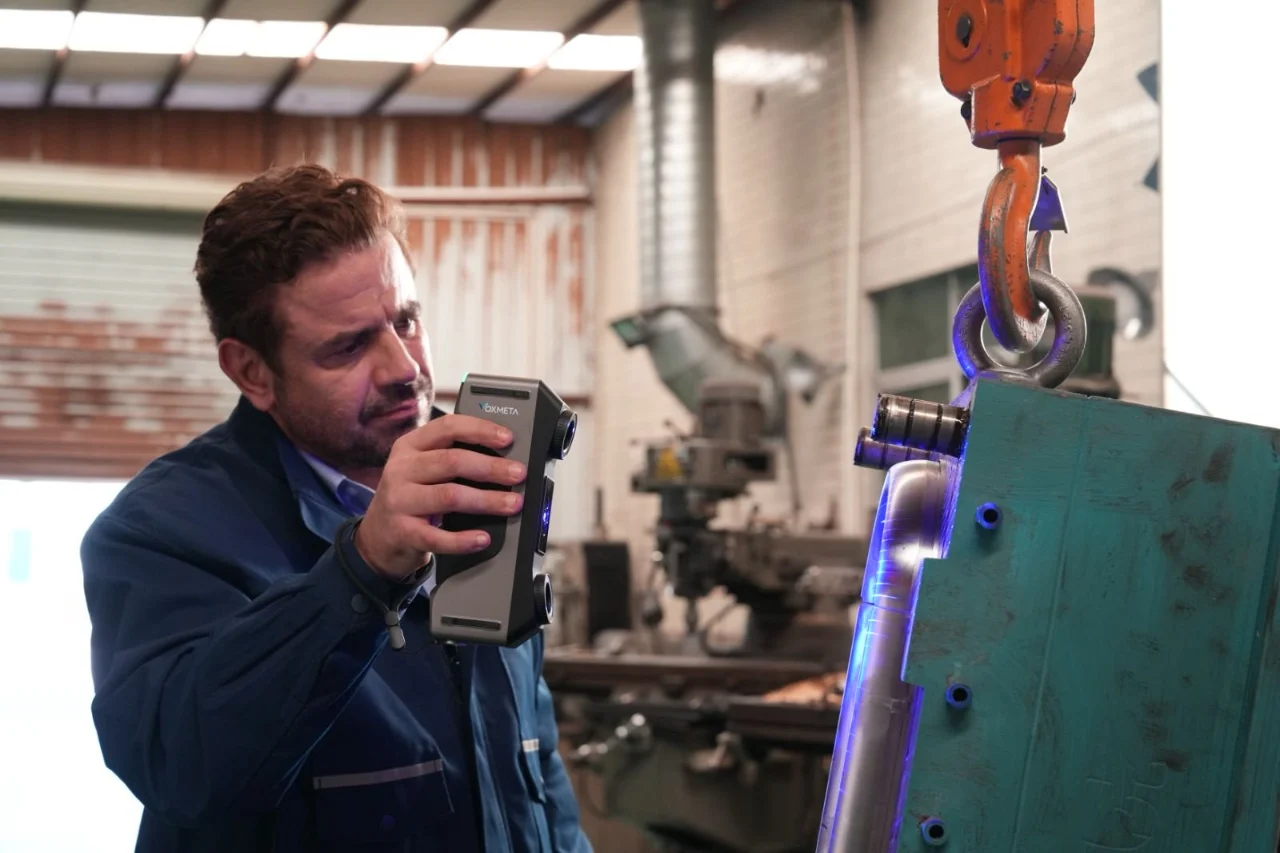
Parts in industrial sites are rarely ideal samples. They may have black surfaces, reflective areas, deep grooves, narrow slots, holes, edges, complex curved surfaces, and irregular structures. Some parts also have machining textures, sprayed coatings, metal reflections, and assembly marks. These real conditions are the key to testing scanner capability.
If a scanner can only perform steadily on simple models, clean surfaces, and standard demonstration environments, it will be difficult to truly meet the needs of industrial users. Industrial users do not scan the same material every day, nor do they always face regular shapes. They need a tool that can handle different parts, different materials, and different surface conditions while continuously producing usable results.
H1 Pro uses blue laser scanning and supports multiple scanning modes, allowing users to switch flexibly according to different workpieces and different areas. When facing larger surfaces, 34 crossed laser lines can help improve scanning efficiency. When facing complex details, 17 fine laser lines can improve data density. When facing deep grooves, narrow slots, and local difficult-to-scan structures, single-line mode can help users capture key geometric information. The final goal is clear: to make scan results more complete, more stable, and more usable.
Making High-Quality Scan Results Easier to Obtain
Industrial users should not waste large amounts of time adapting to a device. A good scanning tool should allow users to reach the result faster, instead of staying too long on adjusting the device, finding angles, trying repeatedly, and waiting for processing. Especially for small and medium-sized industrial teams, time, labor, and project schedules are tight. The heavier the scanning process is, the harder it is for the tool to be used frequently.
H1 Pro emphasizes the combination of high-quality results and an efficient workflow. It has a 120 FPS scanning frame rate and up to 4.4 million points/s data acquisition capability, helping users obtain complete surface data faster. For real industrial projects, speed is not a gimmick, but an efficiency performance under a standardized workflow. The higher the scanning efficiency is, the earlier teams can enter processing, analysis, modeling, and decision-making.
VoxMeta’s slogan is Built for Precision & You. The focus of this sentence is not only precision, but also you. If accuracy only stays in the laboratory, parameter sheet, and promotional materials, its value is incomplete. Accuracy must return to the hands of users, to real parts, and to the people who need to make judgments, perform inspections, and carry out reverse engineering.
VoxMeta H1 Pro has already launched on Kickstarter, with the early bird price starting at $1,899. Compared with the regular price of $3,499, users can save $1,600 during the Kickstarter launch.
Result Orientation Is the Standard for Industrial 3D Scanning
The competition in industrial 3D scanning is moving from device demonstration to result verification. In the future, users will not only look at parameter sheets, nor will they only listen to how brands describe device capability. They will pay more direct attention to whether the scanned STL is accurate, whether the point cloud is stable, whether complex surfaces are complete, and whether the data can enter the next engineering workflow.
This means that a truly valuable industrial 3D scanner must speak through results. Parameters, functions, and hardware capabilities are all important, but in the end, they all need to answer one question: can the scanned result actually be used?
VoxMeta H1 Pro builds its value around this question. We do not want users to only remember a device. We hope users can truly obtain reliable industrial 3D data. In the end, industrial 3D scanning is not about whose promotion sounds louder, but about who can deliver results that are more accurate, more stable, more efficient, and more ready for real work.
VoxMeta H1 Pro Has Officially Launched on Kickstarter
VoxMeta H1 Pro has officially launched on Kickstarter, with the early bird price starting at $1,899. Compared with the regular price of $3,499, you can save $1,600 during the Kickstarter launch.
For teams that need reliable industrial-grade 3D data, this is a more accessible opportunity to bring metrology-grade scanning capability into real projects. H1 Pro features up to 0.015 mm accuracy, blue laser scanning, multiple scanning modes, 120 FPS scanning frame rate, and up to 4.4 million points/s data acquisition capability, helping users obtain usable digital data from real parts faster.
If you are working on reverse engineering, dimensional inspection, CAD comparison, product development, or small-batch production, follow the VoxMeta H1 Pro Kickstarter launch and become one of the first users to bring H1 Pro into your real workflow.
H1 Pro is not just built for scanning. It is built for accurate results, efficient workflows, and real industrial projects.
Disclosure: Some of our articles include affiliate links. If you buy something through one of these links, techschimp Gadgets may earn an affiliate commission. Learn about our Disclosure Policy.