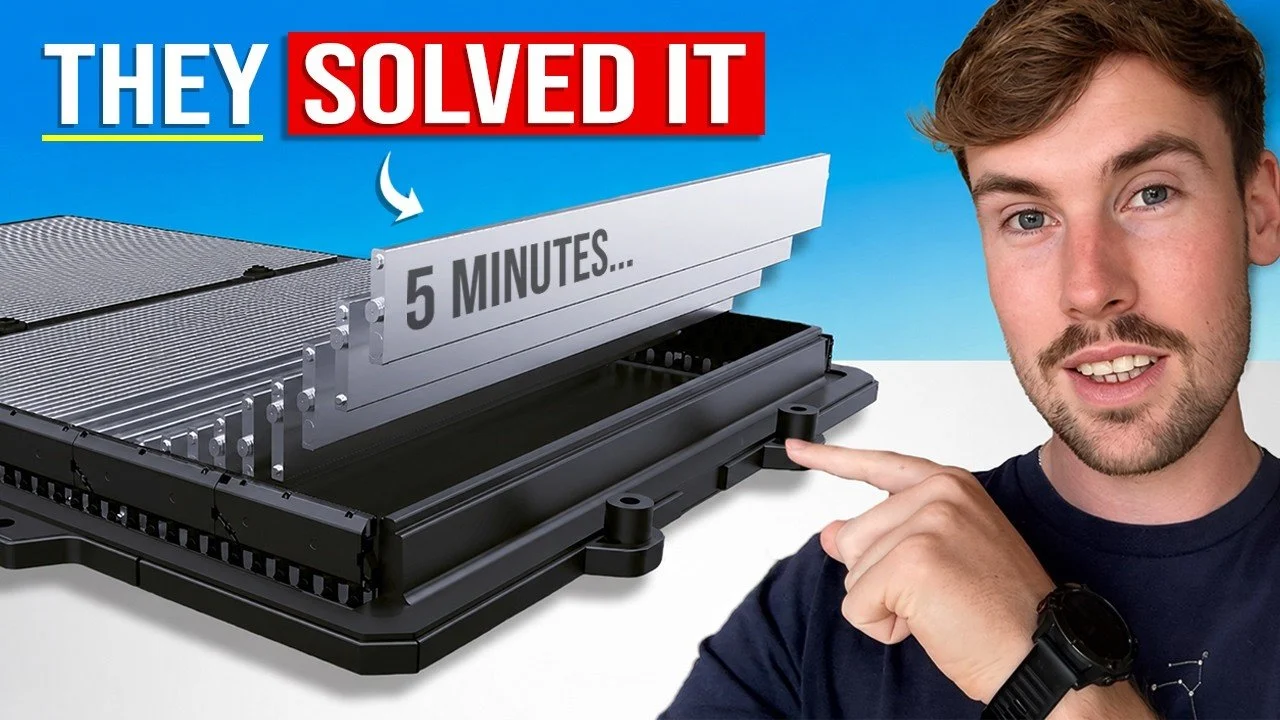
The BYD Blade Battery 2.0 brings a new level of efficiency and accessibility to electric vehicle (EV) technology. Highlighting its use of lithium iron phosphate (LFP) chemistry, this battery achieves superior thermal stability, enhanced safety and a longer lifespan compared to traditional lithium-ion options. Ziroth explores how BYD has further refined this chemistry by incorporating silicon into the graphite anode, boosting energy density to 210 Wh/kg while maintaining rapid charging capabilities. With configurations tailored for either high power or high energy density, the Blade Battery 2.0 offers flexibility for a range of EV applications, from compact city cars to extended-range SUVs.
Dive into this explainer to understand how the Blade Battery 2.0 addresses critical EV adoption challenges. You’ll gain insight into its ultra-fast charging infrastructure, featuring 1.5 MW flash chargers and liquid-cooled cables, as well as its ability to achieve a 10-70% charge in just five minutes. Explore the rigorous safety standards that ensure reliability under extreme conditions and discover how BYD’s system-level integration optimizes performance across vehicles and chargers. This breakdown offers a comprehensive look at the technology driving the next wave of electric mobility.
Innovative Battery Chemistry and Design
TL;DR Key Takeaways :
- The BYD Blade Battery 2.0 introduces ultra-fast charging, achieving a full charge in 9 minutes and a 10-70% charge in just 5 minutes, while maintaining safety and efficiency even in extreme conditions.
- Using advanced lithium iron phosphate (LFP) chemistry and silicon-enhanced graphite anodes, the battery offers superior thermal stability, enhanced safety and an energy density of 210 Wh/kg.
- A next-generation charging infrastructure supports up to 1.5 MW power with liquid-cooled cables, a 1,000-volt architecture and scalability for urban and rural deployment.
- System-level integration optimizes performance, safety and efficiency by unifying the battery, vehicle and charger, reducing energy loss and operational costs.
- Mass production and global expansion plans include 20,000 flash chargers by 2026, positioning the Blade Battery 2.0 as a scalable solution for accelerating EV adoption worldwide.
At the core of the Blade Battery 2.0 is its reliance on lithium iron phosphate (LFP) chemistry, a well-established and cost-effective choice in the EV battery market. Compared to traditional lithium-ion batteries, LFP chemistry provides superior thermal stability, a longer lifespan and enhanced safety, making it ideal for high-demand applications. BYD has further refined this chemistry by improving the electrochemical structure, allowing faster lithium-ion movement and enhanced ionic conductivity.
The battery design incorporates silicon into the graphite anode, a key innovation that increases energy density while supporting rapid charging without compromising safety. This advanced configuration allows the battery to achieve an impressive energy density of 210 Wh/kg. Additionally, the Blade Battery 2.0 is available in two configurations: one optimized for high power and another for high energy density. This flexibility enables automakers to tailor the battery to meet diverse vehicle requirements, from compact urban EVs to long-range electric SUVs.
Next-Generation Charging Infrastructure
The Blade Battery 2.0 is supported by a state-of-the-art charging infrastructure designed to meet the demands of ultra-fast charging. Flash charging stations, equipped with grid load buffer batteries, can deliver up to 1.5 MW of power, making sure grid stability even during peak usage periods. This infrastructure is a critical component in making EV charging as convenient and efficient as refueling traditional vehicles.
Key features of this advanced charging network include:
- Liquid-cooled charging cables to prevent overheating during high-power charging sessions.
- A 1,000-volt architecture that enhances both charging efficiency and safety.
- Scalability for deployment in diverse locations, including urban centers and rural areas.
These features ensure that the charging network remains reliable, efficient and capable of supporting the growing number of EVs on the road. By addressing infrastructure challenges, BYD is paving the way for widespread EV adoption.

Deep dive into the latest in energy by exploring our other resources and articles.
Exceptional Performance and Safety Standards
The Blade Battery 2.0 sets a new standard for charging speed and performance. A full charge can be achieved in just 9 minutes, while a 10-70% charge takes as little as 5 minutes. Even in extreme cold conditions, down to -30°C, the battery’s preheating system ensures efficient charging, making it suitable for a wide range of climates and environments.
Safety remains a cornerstone of the Blade Battery 2.0. The battery has undergone rigorous testing to ensure stability and reliability under various conditions. These tests include:
- Puncture resistance to prevent thermal runaway in the event of physical damage.
- Exposure to high temperatures to verify thermal stability.
- Prolonged use testing to confirm durability over time.
With a lifespan of 5,000 cycles and warranties covering up to 155,000 miles, the Blade Battery 2.0 offers durability and reliability that inspire confidence among consumers and automakers alike.
Integrated System-Level Efficiency
BYD has adopted a holistic approach to the Blade Battery 2.0, integrating the battery, vehicle and charger into a unified system. This system-level integration ensures seamless communication between components, optimizing performance and safety. Advanced cooling systems and battery management technologies work together to minimize energy loss during charging and discharging cycles, making sure maximum efficiency.
This integrated approach not only enhances the overall performance of the battery but also reduces operational costs for automakers and end-users. By streamlining the interaction between the battery and the vehicle, BYD has created a solution that is both practical and forward-thinking.
Scalability and Global Expansion
Mass production of the Blade Battery 2.0 is already underway, with thousands of flash chargers installed across China. BYD plans to expand this network to 20,000 chargers by the end of 2026, with significant growth anticipated in Europe, the UK and other global markets. This large-scale deployment highlights the scalability of the technology and its potential to meet the rising demand for EVs worldwide.
The Blade Battery 2.0’s scalability is further supported by its adaptability to various vehicle types and charging infrastructures. This flexibility ensures that the technology can be seamlessly integrated into existing EV ecosystems, accelerating the global transition to sustainable transportation.
Shaping the Future of Electric Mobility
The BYD Blade Battery 2.0 represents a significant leap forward in EV technology. By addressing two critical barriers to EV adoption—cost and charging convenience—it makes electric vehicles more practical and appealing to a broader audience. With its advanced chemistry, robust charging infrastructure and system-level optimization, this innovation has the potential to drive the global shift toward sustainable transportation.
As deployment continues to expand, the Blade Battery 2.0 is poised to play a pivotal role in shaping the future of mobility. Its combination of performance, safety and scalability positions it as a cornerstone of the next generation of EV technology, offering a glimpse into a cleaner, more efficient transportation landscape.
Media Credit: Ziroth
Disclosure: Some of our articles include affiliate links. If you buy something through one of these links, techschimp Gadgets may earn an affiliate commission. Learn about our Disclosure Policy.