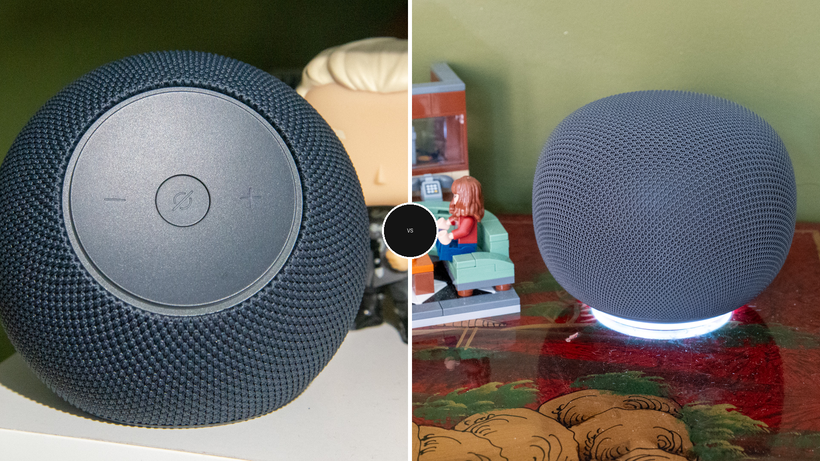
Small smart speakers have been around for a long time, but requirements have changed. Gone are the days of super-cheap speakers built only for voice responses; people now expect quality audio performance first and foremost. And, with GenAI-powered voice assistants now the norm, these speakers need to do more.
The two main competitors are the Amazon Echo Dot Max (powered by Alexa+) and the Google Home Speaker (powered by Google Gemini for Home). wWe’ve tested both hands-on, so here’s how they compare.
Both speakers are compact, shelf-friendly models that cost the same: $99\£99. They’re both quite similar in size and look very similar, too, with a mesh material coating on the outside. The Echo Dot Max is available in three colours (graphite, amethyst and glacier white); the Google Home Speaker is available in porcelain, hazel, jade and berry (although only the first two are available in the UK).
Amazon has put its controls front and centre, with volume controls and mute all easy to reach. Google is a little more subtle, and has tap controls: on-top to play/pause or stop a response, and either side to lower or increase volume. The Google Home Speaker’s mute switch is a bit harder to reach, hidden at the back.
Amazon uses a regular power adaptor for its speaker, but Google has a captive cable that terminates in USB-C. I prefer a removable cable, just in case it gets damaged.
Both have status lights that change colour based on what the speaker is doing.
Winner: Draw
Alexa+ is the more accomplished voice assistant: it’s natural to talk to, can build routines, book restaurants, and even pull data from photos and PDFs.
Google Gemini For Home is slightly more basic: it handles general requests well, but it’s slower to respond, can’t handle PDFs, sometimes responds in a way that doesn’t make sense, and it can make automations.
When it comes to little touches, Alexa+ is ahead, too. For example, Alexa+ will remember facts and use them to fine-tune its responses, and it can responds in a whisper if you whisper a request.
The main area that Google Gemini For Home wins in is for local business searches. Alexa+’s information is quite out of date, but Google pulls in up-to-date information. Sadly, Gemini lacks advanced features, such as the ability to book restaurants; Alexa+ can do this through its OpenTable integration.
Winner: Amazon Echo Dot Max
The Echo Dot Max pairs a 0.8-inch tweeter with a 2.5-inch woofer, and it’s a neat combination. Sound is clean, well-balanced, and holds up on bass-heavy tracks, such as Rage Against the Machine’s Bomb Track. This speaker won’t shake the room, but it handles itself well. And it supports lossless Spotify audio.
Google’s Home Speaker has omnidirectional sound, and it does fill a room naturally, and can handle heavy bass tracks. The catch is that it trips over quieter material, and it starts to strain at higher volumes on anything aggressive. Losless Spotify audio was not supported.
Neither one gives you real stereo separation from a single unit, but eitehr can be used as part of a stereo pair. The Echo Dot Max wins this round because its two-driver setup just sounds cleaner and more consistent across a wider mix of music.
Winner: Amazon Echo Dot Max
The Google Home Speaker is a Thread border router with Matter support, so you can connect modern devices directly to it. The Echo Dot Max has the same, but it also has a Zigbee radio, temperature sensor and ultrasound presence detection built-in, making it more flexible when used as part of a routine.
Alexa+ can make routines via voice commands, but Gemini lacks this ability. Both can handle complex commands quite well, such as asking to turn on multiple discrete devices in one sentence.
Winner: Amazon Echo Dot Max
The Echo Dot Max crams a surprising amount of smart home hardware for its price: Zigbee, Thread, Matter, a temperature sensor, and ultrasound presence detection.
Google’s speaker costs the same but its hardware is a touch more limited.
Overall, Gemini For Home holds the Google Home Speaker back, and the combination of the Echo Dot Max and Alexa+ is the better one.
Winner: Amazon Echo Dot Max
If you want a smart home hub, a capable voice assistant, and genuinely decent sound, the Echo Dot Max is the best choice. It has better smart home hardware, including built-in Zigbee, Thread, and Matter; Alexa+ is better where it counts; and audio quality is slightly better.
The Google Home Speaker has fine hardware, and it’s good to have Thread and Matter support along with decent audio. Unfortunately, Google Gemini For Home lets it down.