Dyson’s return to robot vacuums with the Spot+Scrub Ai is a genuine second chance after its last robot, the 360 Vis Nav, was widely written off for weak navigation and a price that outran its feature set. Roborock, meanwhile, has spent the years since that first Dyson misfire building the category’s most consistent flagship line, refreshing its Saros series annually while Dyson’s robot vacuum efforts have arrived years apart.
This piece compares both brands’ current and recent hardware on the things that actually decide a robot vacuum purchase: navigation, suction, mopping, app maturity and long-term reliability.
Anyone still narrowing down options more broadly should check our best robot vacuum guide before committing to either brand specifically.
Specs table – Dyson Spot+Scrub Ai / Dyson 360 Vis Nav vs Roborock Saros 10 / Saros 20
| Spec | Dyson 360 Vis Nav | Dyson Spot+Scrub Ai | Roborock Saros 10 | Roborock Saros 20 |
|---|---|---|---|---|
| UK price | Discontinued | £1,049.99 | £1,199 | £1299 |
| Suction power | Not officially Pa-rated | 18,000Pa | 22,000Pa | 36,000Pa |
| Navigation | Camera-based SLAM | LiDAR with green laser dirt detection | LiDAR | StarSight Autonomous System 2.0 (vision-based, 300+ obstacle types) |
| Battery runtime | Up to 50 minutes | Around 200 minutes | 180 minutes | 200 minutes |
| Bin/dustbin capacity | 570ml (robot only) | 3-litre bagless dock bin | 2-litre dock bin | 2-litre dock bin |
| Mopping | None | Roller mop, continuous fresh water feed | Included | Included |
| Self-emptying dock | No | Yes, bagless | Yes, 10-in-1 multifunction | Yes, hot-water self-cleaning |
Dyson’s two generations sit closer together on price than Roborock’s, but the spread in suction and dock sophistication across Roborock’s own lineup shows just how fast that side of the category is moving, with the Saros 20’s 36,000Pa suction figure roughly double what the Saros 10 offers barely a generation later. This table doesn’t even include Roborock’s extended range with its cheaper Qrevo models.
Dyson vs Roborock price and current lineup
Dyson’s robot vacuum range is deliberately small, currently spanning just two generations.
Roborock takes the opposite approach entirely, refreshing its flagship Saros line on a near-annual cycle, with the Saros 10 already sitting alongside the newer Saros 20 rather than being fully replaced by it.
That difference in release pace matters beyond just having more choice on a shelf, since a buyer picking Roborock today is choosing into a brand that iterates quickly on navigation and mopping software, while a Dyson buyer currently has a choice of one model.
Buyers who aren’t in a rush may find waiting a few months narrows the price gap between the two brands considerably, particularly on whichever Roborock generation sits just behind the current flagship.
Roborock wins on navigation and obstacle avoidance
This is Roborock’s clearest advantage over Dyson at the current generation. Roborock’s flagship models use a low-profile chassis design that fits under furniture; Dyson’s bulkier robot simply can’t reach. Roborock also has more advanced hazard-recognition systems that spot cables, pet toys and other clutter reliably enough to run unsupervised.
The newer Spot+Scrub Ai improves on the previous model with LiDAR navigation and a distinctive green laser for dirt detection, a genuine step forward, but even in its newest form the Dyson still runs into more furniture and tight spaces than Roborock’s slimmer, more mature hazard-avoidance systems manage.
Robrock leads on suction and carpet performance
The new Dysom Spot+Scrub Ai might be better overall than its predecessor, but it doesn’t have as much power. It’s good on carpet, but not the best.
Roborock’s flagship models generally deliver strong, well-rounded debris pickup across both hard floors and carpet, and tend to edge out Dyson on overall pickup consistency across a full home rather than any single surface type.
Mopping and self-cleaning docks: Dyson vs Roborock
Mopping is where the gap between the two brands has narrowed the most with Dyson’s newest release, though it hasn’t closed entirely.
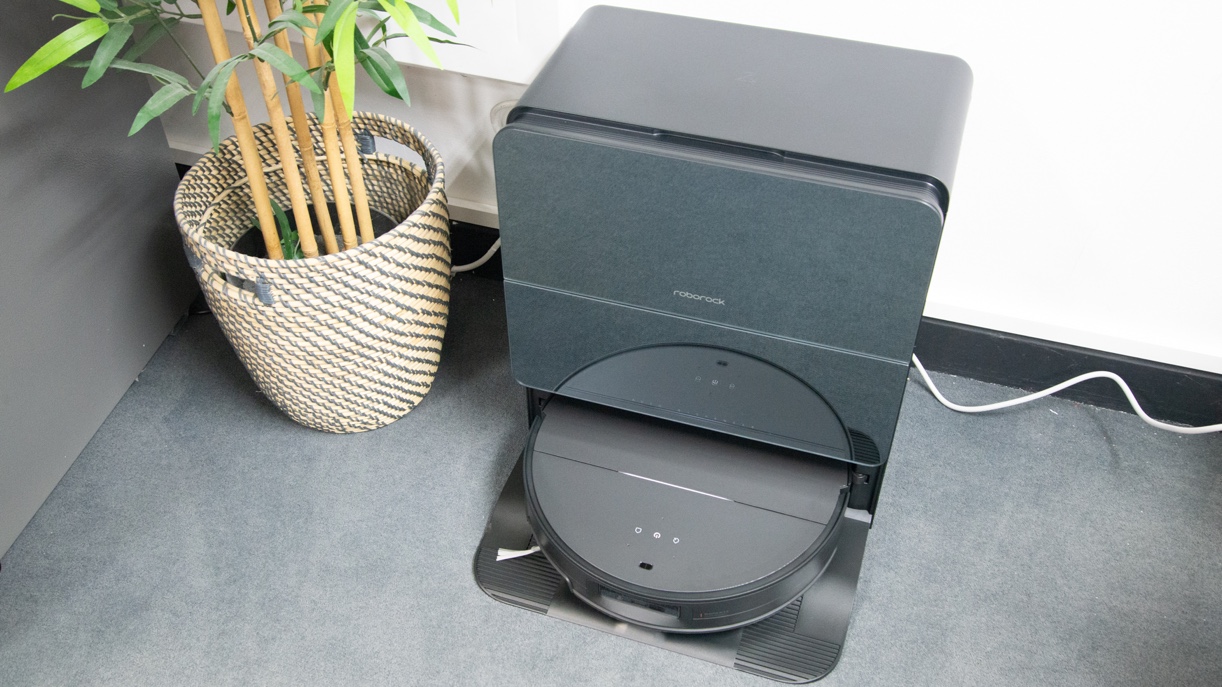
The Spot+Scrub Ai’s bagless, self-emptying dock is a real step forward from the 360 Vis Nav, which had no self-emptying capability at all and required much more hands-on maintenance as a result. The new dock also handles water tank refilling and mop pad cleaning automatically, closing a gap that used to be one of Dyson’s biggest weaknesses against the rest of the category.
Our review of the Spot+Scrub Ai still found real limits to how well it handles the toughest messes, noting it “struggles with very tough stains, such as ketchup even after spraying with kitchen cleaner,” which points to Dyson’s mopping system still trailing the most refined roller-mop and dual-pad systems Roborock and its closest rivals now offer as standard on flagship models.
And, Roborock’s flagship models can leave their mop pads behind, so the robots do better on mixed flooring types.
Roborock’s app outclasses Dyson’s
Roborock’s app remains meaningfully more sophisticated than Dyson’s, offering deeper scheduling and customisation options, remote live camera viewing on supported models, and more granular control over cleaning routines than Dyson currently provides.
Dyson’s app has improved with the Spot+Scrub Ai but was still flagged in our own review as a limitation worth noting.
For anyone who wants to fine-tune cleaning zones, review live footage or lean on more advanced automation, Roborock’s software maturity is a real practical advantage that shows up in daily use far more than a spec sheet suggests.
Dyson vs Roborock: reliability, longevity and spare parts
Reliability concerns show up across the entire robot vacuum category right now rather than being specific to either brand, with owners frequently reporting mixed experiences getting warranty repairs or replacements handled smoothly regardless of manufacturer. That broader uncertainty makes Dyson’s established UK service network and physical retail presence a genuine point in its favour for buyers who value straightforward, in-person support over navigating an online repair process.
Meanwhile, Roborock counters with cheap, widely available third-party replacement parts, which keeps long-term running costs down even if official support can be slower to reach in some cases. Buyers who’ve previously had a good experience with either brand’s wider product range, such as an existing Dyson stick vacuum or Crosswave owner, may reasonably weight that established trust more heavily than a spec-by-spec comparison would suggest on its own.
Cost of ownership over several years is worth factoring in alongside the upfront price too, since Roborock’s faster release cycle means older flagship generations tend to hold their resale and part-compatibility value less predictably than Dyson’s smaller, slower-moving range. A Roborock buyer picking up the current flagship today is generally choosing a device that will feel dated faster given how quickly the category moves, while a Dyson buyer is more likely to still be using broadly current hardware several years on simply because the brand releases new robot vacuum generations far less often.
Who should still pick Dyson
Despite Roborock’s advantages across navigation, app sophistication and overall debris pickup, Dyson’s new robot is a world ahead of its old one, and if you can buy if on offer, it’s a great choice.
For everyone else, particularly buyers prioritising hands-off automation, mixed-surface homes, or the most polished app experience, Roborock remains the stronger overall choice.
Dyson or Roborock? Here’s our final call
Roborock wins this comparison for most buyers, delivering more consistent navigation, a more capable app, and better mopping across a wider range of home layouts, all while iterating faster on new hardware than Dyson currently does.
Dyson’s comeback with the Spot+Scrub Ai is real progress and closes much of the gap that made the 360 Vis Nav easy to dismiss, particularly on dock convenience, but it still trails on the software and sensor side of the experience that increasingly defines what separates a good robot vacuum from a great one.
The post Dyson vs Roborock: which robot vacuum brand wins in 2026? appeared first on The Ambient.