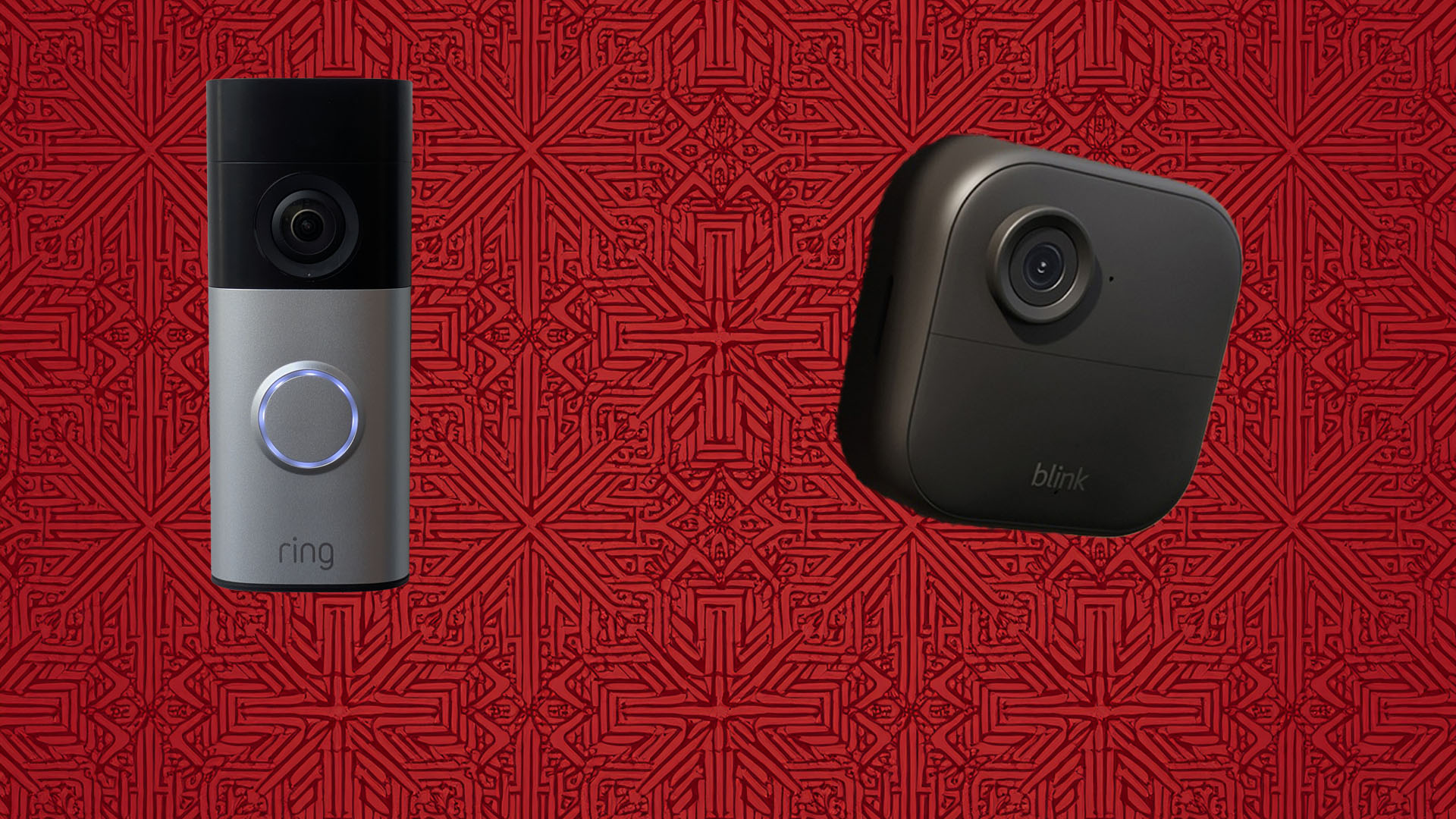
Ring and Blink both are both owned by Amazon, but they’re built for different buyers with different priorities. Ring offers a broad security ecosystem that stretches from standalone cameras to a full alarm system with monitoring, while Blink keeps things simple with budget-friendly cameras, long battery life, and the option to store footage locally without paying a monthly fee.
We’ve tested several Blink products hands-on, including the Blink Video Doorbell and the Blink Mini 2, and we’ve covered Ring’s indoor camera lineup in detail through our Ring Pan-Tilt Indoor Cam vs Indoor Cam comparison. If you’re shopping for home security cameras more broadly, our best smart home security cameras guide covers the full field.
The short version: Blink is the better pick if you want cheaper, low-maintenance cameras; Ring is the stronger choice if you want a security platform that can grow with your home. Here’s how they compare across every category that matters.
Ring vs Blink price and availability
- Blink’s entry-level cameras start at $29.99 / £29.99, roughly half the price of Ring’s cheapest indoor option
- Ring’s range runs wider and higher, from $49.99 / £49.99 indoor cameras up to $279.99 / £219.99 floodlight cams
- Both brands are available in the US and UK, though Ring has broader international availability
Blink’s pricing is one of its strongest selling points, and it shows across the entire lineup. The Blink Mini starts at $29.99 / £29.99 for a compact plug-in indoor camera, while the Blink Outdoor 4 costs $79.99 / £79.99 bundled with a Sync Module. Doorbells start at $49.99 / £49.99 for the Wired Doorbell 2K+, or $69.99 for the Battery Doorbell 2K+. The Blink Wired Floodlight Camera comes in at $99.99.
Ring’s lineup starts higher. The Ring Indoor Cam costs $49.99 / £49.99, the Outdoor Cam sits at $79.99, and prices climb steadily through the Spotlight Cam Plus at $149.99 / £179.99 to the Floodlight Cam Wired Pro at $229.99 / £219.99. Ring doorbells span a wide range too, from $59.99 for the base Video Doorbell up to $349.99 for the Video Doorbell Pro 2.
The gap narrows at the mid-range, where a Blink Outdoor 2K+ at $99.99 sits close to a Ring Outdoor Cam at $79.99, but Blink consistently undercuts Ring at the entry level, and the savings compound when you’re buying multiple cameras for a full home setup.
Ring vs Blink camera and doorbell lineup
Ring offers the broader product range by a comfortable margin, something we’ve seen firsthand across our reviews of the Ring Spotlight Cam, Ring Stick Up Cam Pro, and Ring Indoor Cam. Its camera lineup spans indoor, outdoor, spotlight, and floodlight categories, each with multiple tiers (standard, Plus, and Pro). The doorbell selection alone includes eight variants covering wired, battery, and solar power options (we cover the full field in our best video doorbells guide). Newer Ring models have pushed into 2K resolution on the Spotlight Cam base models, with 4K available on Pro-tier cameras and select doorbells.
Blink’s range has expanded significantly over the past year. The lineup now includes the Mini, Mini 2, and Mini 2K+ for indoor use, the Outdoor 4 and Outdoor 2K+ for weatherproof coverage (both feature in our best outdoor security cameras roundup), a solar-powered Solaris 2K+, a Wired Floodlight Camera, and both wired and battery doorbell options in 2K+. The Blink Outdoor 4, upgraded its field of view to 143 degrees (up from 110 on previous generations) and improved its night vision performance over earlier models.
In our Blink Video Doorbell review, we found the video quality to be “well exposed” in daylight but softer than the competition, with infrared night vision that struggled in low light beyond a few feet. Ring’s doorbells consistently deliver sharper footage, particularly at night, as we noted in our Ring Battery Video Doorbell Plus review, and that quality gap is something users who own both brands regularly confirm. Where Blink closes the distance is on its wired indoor cameras. In our Blink Mini 2 review, we noted the 143-degree field of view and motion sensitivity were both excellent for the price, and the camera’s compact size makes it easy to place discreetly.
Ring’s People Only mode, which filters motion alerts to trigger only when a person is detected, is available across most of its lineup. Blink offers person detection as well, but only on compatible devices and only with a paid subscription plan.
Ring vs Blink storage: cloud vs local
- Blink offers local storage through its Sync Module with a USB drive (up to 256GB), with no subscription required
- Ring has no local storage option; all video recording requires a Ring Protect plan
- During cloud outages, Blink’s local recordings remain accessible; Ring’s do not
This is the single biggest structural difference between the two brands, and it directly affects how much you’ll spend over the life of your system.
Blink’s Sync Module (bundled with outdoor cameras or available separately) accepts a USB flash drive of up to 256GB, and all motion-triggered clips save directly to it. No subscription, no cloud dependency, no monthly fee. The footage sits on hardware you physically own, and it stays accessible even if your internet drops.
Ring requires a Ring Protect subscription for any recorded video. Without one, you get live view and real-time motion alerts, but the moment passes and there’s no footage to review. There is no SD card slot, no USB option, and no local recording workaround. This is a genuine frustration for Ring owners and one of the most common complaints in online communities, with some users saying they’re considering leaving the ecosystem entirely because of it.
For anyone who wants basic security coverage without ongoing costs, Blink’s local storage option is one of its most compelling advantages. For a deeper breakdown of what each Blink tier includes, our Blink subscription plans explainer covers the full picture.
If you do use Blink without a subscription, you lose the advanced features: people detection or advanced AI alerts. As such, there are more feature-rich cameras from other manufacturers that don’t require a subscription, such as Reolink or Eufy.
Ring vs Blink subscription costs compared
Both brands offer tiered subscription plans, but the critical difference is that Blink works meaningfully without one and Ring does not.
Blink’s plans start at $3.99/month (£2.50) for a single camera on the Basic plan, which includes 60 days of cloud storage, motion-triggered recording, and video sharing. The Basic AI plan at $6.99/month adds smarter detection features. The Plus plan covers unlimited cameras for $11.99/month (£8), and Plus AI runs $19.99/month. Without any subscription, Blink still offers live streaming (limited to five minutes per session), basic motion alerts, two-way audio, activity zones, full Alexa integration, and local storage through the Sync Module.
Ring’s Solo plan costs $4.99/month (£4.99) for a single device with 180 days of video history. The Multi plan at $9.99/month (£7.99) extends coverage to all cameras at one address. The Pro plan at $19.99/month (£15.99) adds familiar face detection, AI descriptions and video search. There’s also a higher plan that offers professional monitoring.
Without a subscription, Ring gives you live view and alerts but no video history, so if something happens while you’re not watching in real time, there’s no recording to check afterward.
Ring’s 180-day video retention is longer than Blink’s 60 days on cloud plans, and its app offers a more polished timeline for scrubbing through footage. But Blink’s free tier is genuinely functional in a way Ring’s is not, and that matters for budget-conscious buyers.
Ring vs Blink smart home and Alexa integration
- Both brands work best within Amazon’s Alexa
- Blink is Alexa-only, with no support for Google Home, Apple HomeKit, or other platforms
- Ring is also Alexa-first; its Google Home integration has been discontinued, though newer Pro-tier devices support Matter
Both Ring and Blink are Amazon-owned, and it shows. Alexa integration is the centerpiece of both platforms, letting you view live feeds on Echo Show devices, receive motion announcements through Echo speakers, and trigger automations through Alexa Routines. In our Blink Mini 2 review, we found the Alexa integration worked seamlessly, with responsive live view on Echo Show and intuitive voice commands.
Beyond Alexa, the picture gets thin. Blink supports no other smart home platform. Ring’s Google Home integration, which once allowed basic controls like starting and stopping recordings, has been discontinued. SmartThings support exists in limited form but offers reduced functionality compared to native Alexa. Ring’s newer Pro-tier devices do support Matter, a universal smart home protocol designed to let devices work across different ecosystems, and that could open the door to broader compatibility with Google Home and Apple Home in the future. But as of mid-2026, that promise is still emerging rather than fully delivered.
If your household runs on Google Home or Apple HomeKit, neither Ring nor Blink is a natural fit. In that case, alternatives like Arlo, Eufy, or Reolink (which also avoids mandatory subscriptions) are worth considering. But if you’re already in the Alexa ecosystem, both brands integrate cleanly, with Ring holding a slight edge on future-proofing through Matter.
Ring vs Blink professional monitoring and alarm
This is where Ring pulls furthest ahead, because Blink simply doesn’t compete in this category.
Ring Protect Pro ($19.99/month / £15.99) includes 24/7 professional monitoring with cellular backup, meaning the system continues to function and alert emergency services even if your internet goes down. The Ring Alarm system integrates door and window sensors, motion detectors, a keypad, and a base station with a built-in siren, all connected through a Z-Wave hub (a wireless protocol commonly used in home automation). Ring also offers optional smoke and CO listener devices and a panic button.
Blink offers self-monitoring only. You receive push notifications on your phone when motion is detected, but there’s no professional monitoring service, no alarm system, no sensors, and no emergency dispatch. If your cameras catch something while you’re asleep or away from your phone, nobody else is watching.
For buyers who want standalone cameras, this category may not matter. But for anyone looking to build out a full home security system from a single platform, Ring is the only option between the two.
Ring vs Blink battery life and installation
- Blink batteries last up to two years on AA lithium cells; Ring batteries last three to six months on rechargeable packs
- Both brands offer straightforward DIY installation
- Blink’s Sync Module adds an extra setup step that Ring doesn’t require
Battery life is one of Blink’s most practical advantages. Its outdoor and doorbell cameras run on standard AA lithium batteries rated for up to two years of typical use, which means less maintenance and no proprietary battery packs to recharge. Ring’s battery cameras and doorbells use rechargeable lithium-ion packs that typically last three to six months, and cold weather can reduce that figure significantly. Users in colder climates regularly report noticeably shorter battery life during winter months.
Both brands are designed for DIY installation with no professional help required. Ring cameras connect directly to your Wi-Fi router, which keeps setup simple. Blink’s wireless cameras route through a Sync Module that acts as an intermediary between the cameras and your network. The module enables local storage, but it also introduces an additional piece of hardware that needs to stay connected and powered. Some users report connectivity issues with the Sync Module, particularly in larger homes where the module sits far from either the router or the cameras.
Wired options on both sides eliminate battery concerns entirely. The Blink Mini 2, which we found set up in about five minutes during our review, plugs directly into a power outlet and connects to Wi-Fi without a Sync Module. Ring’s plug-in Indoor Cam and wired Floodlight Cams offer the same always-on reliability.
Ring vs Blink verdict: which should you buy?
If you want affordable home security with minimal ongoing costs, Blink is the stronger pick. Its local storage option means you can record and review footage without ever paying a subscription, the two-year battery life keeps maintenance low, and the cameras themselves cost less than Ring’s equivalents at nearly every price point. The wired Blink Mini cameras are particularly good value for indoor use. The trade-offs are real: video quality trails Ring, especially at night and on doorbells, and the Sync Module can be finicky. But for budget-conscious buyers, renters, or anyone setting up their first system, Blink delivers a lot for the money.
If you want a security platform that can scale into a full home protection system, Ring is worth the higher investment. The product range is broader, video quality is consistently sharper, the app experience is more polished, and nothing else in Amazon’s ecosystem matches Ring Alarm with professional monitoring for a complete security setup. You’ll pay more upfront and through monthly subscriptions, but you’re getting a more capable system that grows with your needs.
Both brands lock you into Amazon’s Alexa ecosystem, so if your smart home runs on Google Home or Apple HomeKit, neither is ideal. For those households, camera brands like Arlo, Eufy, or Reolink are worth a look before committing. Reolink in particular avoids subscription fees entirely and carries no ecosystem lock-in.
The post Ring vs Blink: which Amazon security camera should you buy? appeared first on The Ambient.