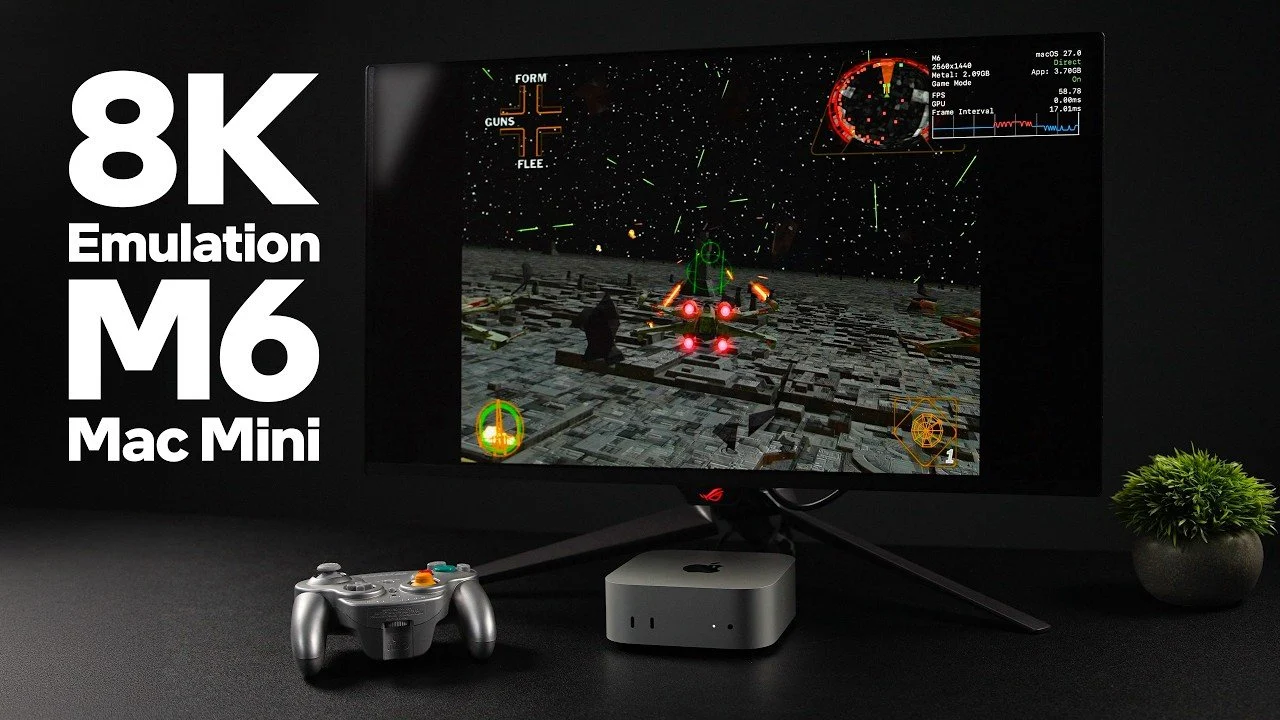
The M6 Mac Mini, powered by Apple’s latest M-series chip, is proving to be a remarkable device for gaming emulation, even at resolutions as high as 8K. In a detailed breakdown, ETA Prime explores how this compact desktop handles demanding platforms like GameCube, Wii and PS2 using emulators such as Dolphin and PCSX2. With Apple’s Metal API allowing smooth performance and enhanced visuals, the M6 Mac Mini achieves feats like running F-Zero GX at 12x native resolution while maintaining a steady 60fps. However, challenges remain with certain platforms, such as PS3 emulation, where the lack of Metal backend support limits performance.
The Apple M6 Mac Mini balances its hardware capabilities with software optimizations to deliver high-resolution gameplay. Explore specific emulator setups, from using Vulkan for PSP titles to navigating the limitations of OpenGL with Original Xbox games. This overview also examines the role of external storage solutions for managing large game libraries and highlights the evolving potential of Apple Silicon in gaming emulation.
Hardware Features and Configuration
TL;DR Key Takeaways :
- The M6 Mac Mini, powered by Apple’s advanced M-series chips, excels in gaming emulation, supporting platforms like GameCube, Wii and PS2 at resolutions up to 8K, showcasing the efficiency of Apple Silicon.
- Its base configuration includes 16GB of unified memory and 256GB of storage, with external SSDs commonly used for expanded game libraries, offering exceptional performance for resource-intensive tasks despite modest specs.
- Apple’s Metal API significantly enhances emulation performance for platforms like GameCube, Wii and PS2, allowing smooth gameplay and high-resolution visuals, while Vulkan and OpenGL backends offer varying levels of compatibility.
- Limitations exist in PS3, PS Vita and Original Xbox emulation due to compatibility issues and reliance on less-optimized backends, though ongoing emulator updates are expected to improve performance over time.
- The M6 Mac Mini’s compact design, efficient thermal management and robust software ecosystem position it as a powerful and portable solution for high-resolution gaming emulation, paving the way for future advancements in macOS gaming.
The M6 Mac Mini comes equipped with a base configuration of 16GB of unified memory and 256GB of internal storage. For gaming and emulation enthusiasts, expanding storage with an external 1TB SSD is a common practice, providing ample space for extensive game libraries and making sure quick access to large files. While these specifications may appear modest compared to high-end gaming PCs, the optimized architecture of the M-series chips allows the M6 Mac Mini to deliver exceptional performance, particularly for resource-intensive emulation tasks.
The compact design of the Mac Mini also makes it an attractive option for users seeking a balance between power and portability. Its efficient thermal management ensures sustained performance during extended gaming sessions, further solidifying its position as a capable device for high-resolution emulation.
Performance Across Emulated Platforms
The M6 Mac Mini demonstrates impressive performance across a range of emulated platforms, delivering smooth gameplay and visually stunning results. Below is a breakdown of its capabilities across various systems:
- Dolphin Emulator (GameCube/Wii): Using Apple’s Metal API, the M6 Mac Mini achieves up to 12x native resolution (8K) while maintaining a steady 60fps. Iconic titles like Rogue Squadron 2 and F-Zero GX run flawlessly, showcasing the efficiency of the Metal backend in enhancing both performance and visual fidelity.
- PPSSPP (PSP): With support for up to 10x resolution (4800×2720) using the Vulkan backend, the M6 Mac Mini delivers sharp visuals and smooth gameplay across a wide range of PSP titles.
- PCSX2 (PS2): Games such as Gran Turismo 4 upscale effortlessly to 12x resolution (7680×5376), while demanding titles like God of War 2 perform seamlessly at 8x resolution. The Metal backend plays a pivotal role in achieving these results, making sure consistent performance.
- RPCS3 (PS3): PS3 emulation remains challenging due to the absence of Metal backend support. While some titles, like Tekken 6, run at 1080p, others encounter graphical glitches or crashes, limiting the overall experience.
- Original Xbox: Emulation is restricted to 4x resolution due to reliance on the less-optimized OpenGL backend, which impacts performance and visual quality.
- Vita3K (PS Vita): Games run at 2x resolution (1080p) using the Vulkan backend. However, compatibility issues persist, with certain titles failing to run or exhibiting graphical errors.
The M6 Mac Mini’s ability to handle such a diverse range of platforms underscores its versatility and the potential of Apple Silicon to redefine gaming emulation.

Browse through more resources below from our in-depth content covering more areas on M6 Mac Mini.
Software Ecosystem and Tools
The M6 Mac Mini benefits from a robust ecosystem of emulation tools and software, which play a crucial role in its performance. OpenEMU, a popular multi-platform emulator, provides a user-friendly interface for managing game libraries and configuring controllers. Its seamless integration with macOS enhances the overall user experience.
Apple’s Metal API is a standout feature, offering significant performance improvements for GameCube, Wii and PS2 emulation. By optimizing graphical rendering, Metal enables the M6 Mac Mini to achieve higher resolutions and smoother gameplay. For platforms that rely on Vulkan or OpenGL backends, performance varies, but these tools ensure flexibility for users seeking compatibility across a wide range of systems.
Limitations and Future Prospects
Despite its impressive capabilities, the M6 Mac Mini is not without limitations. Compatibility issues are most evident in PS3 and PS Vita emulation, where some games fail to run or exhibit graphical glitches. These challenges stem from the lack of optimization in certain emulators, particularly those that do not yet support the Metal API. Additionally, the reliance on OpenGL for Original Xbox emulation restricts performance and resolution scaling.
However, ongoing development in the emulation community offers hope for improvement. Updates to emulators like RPCS3 and Vita3K are expected to address compatibility issues and enhance performance over time. As developers continue to refine their tools, the M6 Mac Mini’s potential for high-resolution gaming emulation is likely to expand further.
Shaping the Future of Gaming Emulation
The M6 Mac Mini sets a new standard for high-resolution gaming emulation in a compact and efficient form factor. From 8K GameCube and Wii emulation to 4K PS2 gameplay, the device showcases the immense potential of Apple Silicon for gaming enthusiasts. While challenges remain, particularly with PS3 and PS Vita emulation, the M6 Mac Mini’s performance is a testament to the advancements in hardware and software integration.
As emulator developers continue to optimize their tools and Apple Silicon evolves, the future of gaming on macOS looks increasingly promising. The M6 Mac Mini not only highlights the current capabilities of Apple’s hardware but also paves the way for further innovation in the realm of high-resolution gaming emulation.
Media Credit: ETA PRIME
Disclosure: Some of our articles include affiliate links. If you buy something through one of these links, techschimp Gadgets may earn an affiliate commission. Learn about our Disclosure Policy.


![AT&T claims iOS 27.0.1 fixes iPhone 18 Pro Max cellular issues, but users disagree [U]](https://shopvante.com/wp-content/uploads/2026/10/iphone-18-photos-32-336x220.jpg)