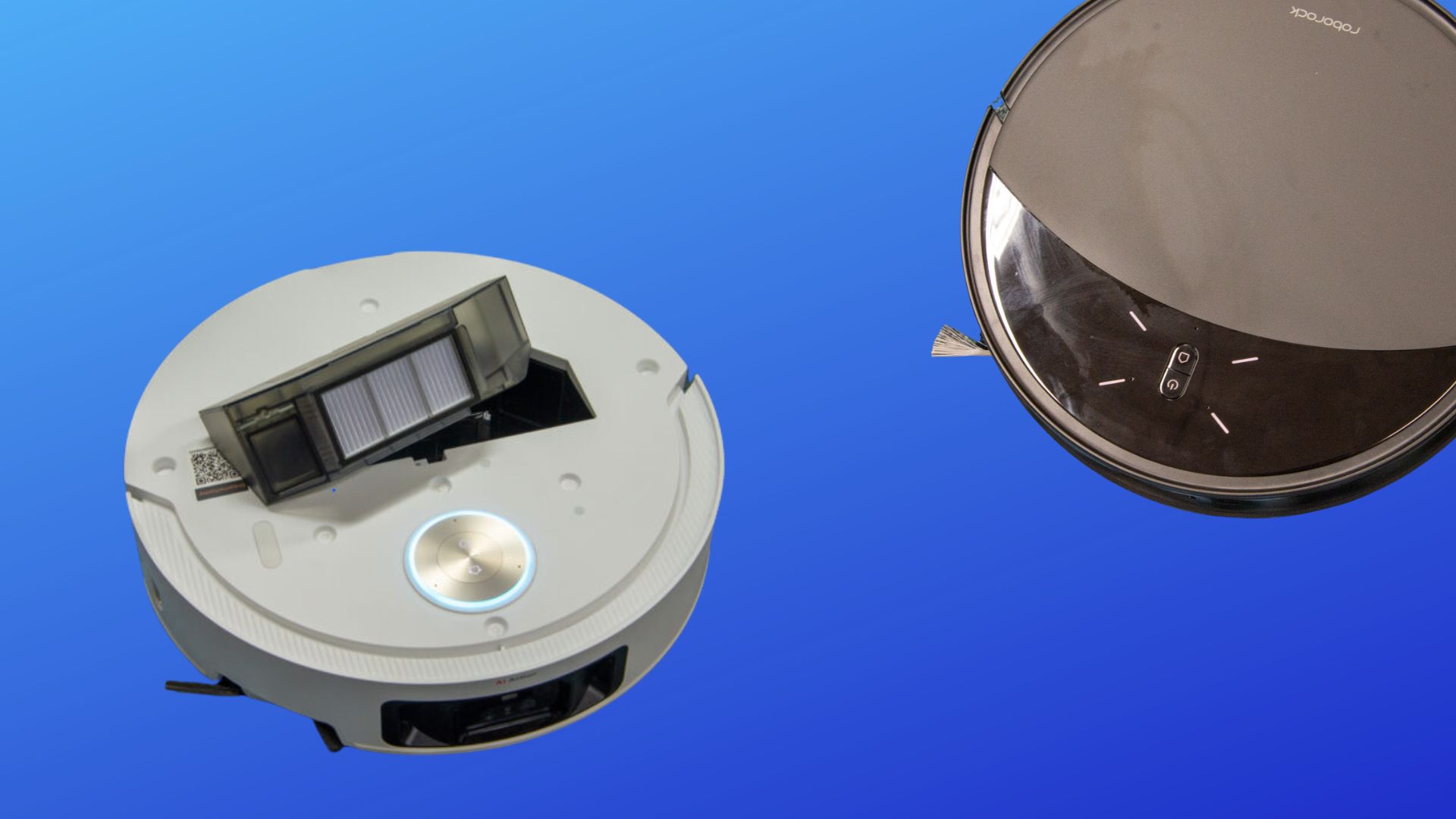
The Roborock Saros 10R and the Dreame X50 Ultra Complete sit at the very top of the robot vacuum market, and both have attracted plenty of attention since launching at CES 2025. If you’re trying to decide between the two, you’re not alone – it’s one of the most common questions we see from readers.
We’ve reviewed both machines extensively here at The Ambient with the sole aim of helping you buy the best robot vacuums on the market. You can read our full Roborock Saros 10R review and Dreame X50 Ultra Complete review for the complete picture. This article draws on both of those hands-on tests to help you decide which one belongs in your home.
Our reviews are the result of living with each robot over an extended period, rather than a quick run-through.
We test each machine across real-world scenarios, covering price and availability, design and build, navigation and mapping, vacuuming and mopping performance, obstacle avoidance, smart home and app features, and pet-friendly performance.
The Dreame X50 Ultra Complete currently sells for around $850 / £643, while the Roborock Saros 10R sits at $1,000 / £756. That $150 gap is often the first thing buyers notice, and it’s a reasonable question whether the Roborock justifies the premium. Based on our testing, the answer depends on what you need it to do – which we’ll cover extensively below.
The Roborock Saros 10R looks similar to the Saros 10, but the key difference is under the hood. It ditches the LiDAR dome found on many rivals – including the Saros 10 – in favour of StarSight Autonomous System 2.0, which uses dual-emitter 3D Time-of-Flight sensors built into the front of the robot. The result is one of the lowest-profile robot vacuums available at just 7.98cm tall, which is particularly handy if you have a lot of low-profile furniture.
The Dreame X50 Ultra Complete takes a slightly different approach to design, with a VersaLift sensor that retracts into the body when low furniture is detected, bringing the height down to 8.9cm. Most of the time, though, the sensor sits on top and maintains a full 360-degree view of your room, giving it a navigational advantage over the front-facing sensor on the Saros.
Both use dual magnetic mopping pads that the dock can pull of automatically for vacuum-only runs, and both machines can lift those pads when carpet is detected. The Saros 10R can lift them by 12mm compared to the X50’s 10.5mm.
In our testing of both machines, neither really had an issue with day-to-day navigation. The Saros 10R’s front-facing sensors mean it scans differently to a top-mounted LiDAR, but as our reviewer noted, there was no discernible difference in navigational ability in practice.
When it comes to obstacle avoidance, both robots rely on their AI-powered front cameras to avoid things like cables, shoes, and mess. In our testing, both performed well and are miles ahead of their cheaper counterparts.
As for mapping, both apps lets you set the floor type for each room, which allows the robot to make the right cleaning decisions – whether to lift the mop pads, boost suction on carpet, or avoid areas entirely. The Roborock gives you granular carpet controls, allowing you to tell the machine to ignore carpets and cross them only when necessary. The Dreame app prompts you to add detected carpets to the floor plan after the initial mapping run, which is a useful feature – although our reviewer found it to be a little overzealous, marking most of the floor as carpet in a mixed-flooring home. Leaving it to detect flooring automatically works much better in our view.
There is one big difference to point out between the two though: the Roborock doesn’t offer a no-mop option, which might be a deal breaker for those with delicate floors,. The Dreame, on the other hand, offers granular control over mopping with 30 different mop wetness levels.
The two robot vacuums have differing approaches to climbing over thresholds like door frames and raised room dividers. The Roborock Saros 10R uses its AdaptiLift chassis to raise its body and cross thresholds up to 40mm – but it required manual configuration in our test: the threshold had to be added to the map in the app before the robot would tackle it.
The Dreame X50 Complete, on the other hand, has retractable legs that allow it to climb over obstacles. It can handle single steps up to 42mm with ease, and two-tier thresholds – like a step and a sliding door rail – up to 60mm. In our testing, the robot achieved this without any intervention.
If your home has complex floor transitions, the Dreame has the advantage here.
Both robots delivered strong results vacuuming across hard floors and carpets in our tests -smashing things like edge cleaning, corner coverage, and everyday mess. This is partly due to the fact both machines are rated at 20,000Pa suction, and have extending side brushes that can reach into crevices and into slats to sniff out crumbs.
They also have excellent pet hair management systems. The Saros has a simple divided main brush to direct pet hair away, while the X50 Ultra Complete has a two-brush system. Both machines passed our tests with pet hair, although the Dreame was able to pick up more than the Roborock.
As for mopping, in our tests, the Saros 10R could handle most stains in two passes – although it needed four attempts to remove a stubborn ketchup stain. The Dreame X50 Ultra Complete performed similarly with advanced settings turned on, including stain recognition and deep mopping modes.
Both use dual spinning microfibre pads, which are washed with 80°C water and dried with hot air in their respective docks.
The Roborock dock features two 3-litre trays for washing. The dirty water one is fully removable, which makes disposal straightforward. The app will also inform you when it’s time to empty the tank and refill the clean one, helping you better plan your cleaning cycles.
The Dreame dock has a slightly bigger 4-litre capacity, meaning the robot can go for longer between refills, but the tray is a bit more fiddly to remove.
They both also come with built-in detergent holders – Dreame comes with a 250ml bottle out of the box, but the Saros doesn’t. That being said, we found it ran well with any hard floor cleaner.
On the app front, both offer integration to popular smart home systems like Alexa and Google Home, as well as Matter. If you want more freedom, though, we like that the Saros 10R is compatible with the Home Assistant open-source platform.
The Dreame X50 Ultra Complete is rated at 220 minutes on its quietest setting compared to the Saros 10R’s at 180 minutes. In testing, both covered a full ground floor on a single charge with power to spare for spot cleaning.
If we had to pick purely on battery, we’d favour the Dreame – but both should be more than capable of tackling a typical home.
Both robot vacuums are excellent, but which one you pick depends entirely on your home and your needs.
We’d recommend the Roborock Saros 10R if you want the lowest possible profile for getting under furniture, you’re building a smart home around Home Assistant, or you want more reliable carpet cleaning controls. Yes, it’s more expensive, but the navigation and cleaning performance justify the price.
The Dreame X50 Ultra Complete is the better option if you have complex floor transitions that the Roborock might otherwise struggle with. It’s also the cheaper option, comes with detergent, and represents better value from these two premium machines.