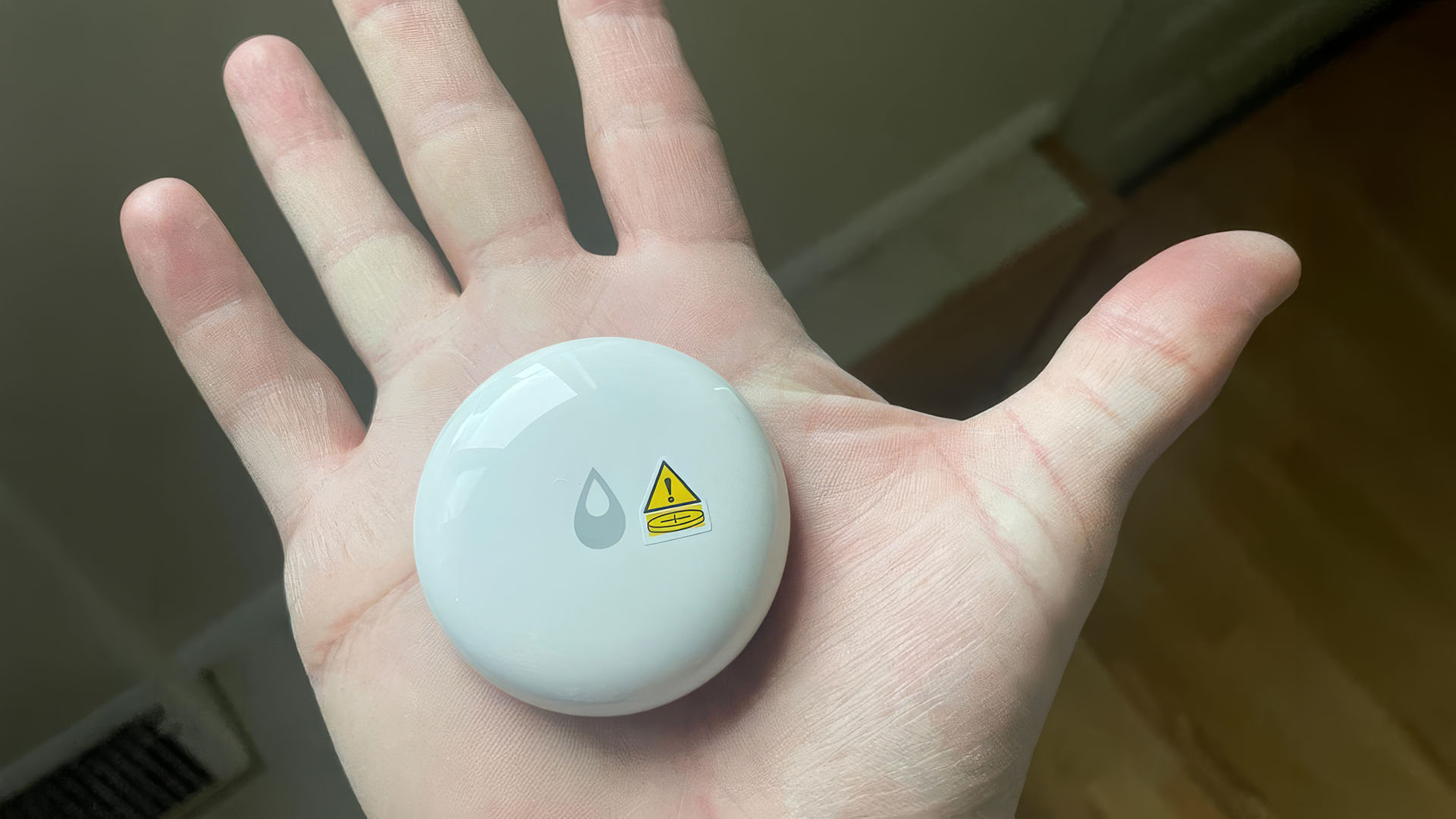
Water damage rarely announces itself. A perished washing machine hose or a pinhole leak behind kitchen units can run for days before you spot the stain, and by then the damage is done. In the UK alone, insurers pay out around £1.8 million every single day on escape of water claims, according to the Association of British Insurers.
A smart water leak sensor, also sold as a smart water leak detector depending on the brand, can help mitigate damage. These small, usually battery-powered devices sit where water shouldn’t be, and the moment they get wet, they ping an alert to your phone, sound a siren, or, in the best setups, shut off your water supply. They’re among the most affordable devices in the smart home, alongside the best motion sensors.
Almost every consumer leak sensor works on the same simple principle: water conducts electricity. On the underside, you’ll find two or more small metal probes, and when water bridges those contacts, a tiny circuit completes and the sensor knows it’s sitting in a puddle. That simplicity is precisely why these devices are cheap, reliable and long-lasting.
Because the detection is passive, most sensors are reusable. Dry the probes after a false alarm or a genuine leak and the device goes straight back to monitoring mode, although it’s worth wiping the contacts occasionally, as dust and limescale can dull their sensitivity.
Some models build on the formula. Many add a second set of contacts on top to catch drips from above as well as pooling below, while others ship with an extension cable or rope-style probe that lets one sensor cover a long run of skirting or the full width of an appliance bay.
Whole-home flow monitors take a different approach. Systems such as Moen’s Flo and Phyn, both far more established in the US than the UK, install on your main water line and monitor flow, pressure and usage patterns for the entire house. Rather than waiting for water to touch a probe, they spot the signature of a leak anywhere in the system, from a running toilet to a pinhole in a wall you could never place a sensor near. The trade-off is cost and installation, since these are plumbed-in devices that often need a professional to fit. LeakBot, popular in the UK through insurer partnerships, splits the difference by clipping onto a pipe and using temperature sensing to spot a constant flow of cold water into the house.
A lot of water damage doesn’t start with a leak; it starts with ice. Water expands as it freezes, splits the pipe from the inside, and the flood only arrives when the thaw does, which is why so many households discover the damage weeks after the cold snap that caused it.
That’s the argument for a sensor that reads temperature as well as moisture. Moen Flo and Phyn both raise a freeze alert when the temperature drops towards the danger zone, typically around 45°F or 7°C, and plenty of cheap pucks now include the same warning. It buys you time to run a tap, lag the pipe or drain the system before anything splits, so prioritise the cold spots: lofts, garages, unheated utility rooms and any pipe run against an external wall.
The protocol question matters more for leak sensors than for almost any other smart home device, because a leak sensor has one job and it needs to do it months or years after you’ve forgotten it exists.
A Wi-Fi water leak detector is the simplest to set up. It connects straight to your router, needs no hub, and sends alerts through the manufacturer’s app from anywhere. The catch is power: Wi-Fi is hungry, so battery life is measured in months rather than years, and a sensor with a flat battery is just a plastic puck. Wi-Fi models are the right call when you only want one or two devices and don’t own, or want, a smart home hub.
A Zigbee water leak sensor sips power by comparison, and the same goes for Z-Wave. Because these low-energy mesh protocols were built for small, sleepy devices, battery life stretches to two, three or even five years on a coin cell or pair of AAs. The trade-off is the hub: an Aqara hub, SmartThings station or Home Assistant setup for Zigbee, or a Z-Wave controller such as Aeotec or Hubitat. If you already run a hub-based smart home, Zigbee or Z-Wave is almost always the better buy, and it keeps working locally even when your internet doesn’t.
There are outliers. YoLink, a fast-growing name in the US, uses long-range LoRa radio via its own hub to reach basements, garages and outbuildings that defeat ordinary wireless, while Meross’s MS405 takes a similar route with sub-GHz 433MHz radio and a claimed 100 metres of range.
Whichever protocol you pick, check what the sensor can actually talk to, because an alert is only useful if it reaches you. A sensor that lands in SmartThings, Home Assistant, Apple Home, Alexa or Google Home can trigger a speaker announcement, flash a lamp red or run a routine, whereas a locked-down single-app device gives you a phone notification and nothing more, which protects nothing at 2am.
Matter is dissolving the walls between these camps. Water leak sensors became an officially supported device type in Matter 1.3, and hubs are catching up: IKEA’s Dirigera now runs Matter 1.3, so the affordable IKEA hub can receive leak alerts from third-party Matter sensors rather than one brand’s kit. Sensor makers are bridging in from the other side, with Meross’s MSH450 hub exposing its 433MHz sensors to Matter, and support either way is the safest futureproofing bet if you’re buying today.
A leak sensor only protects the few centimetres of floor it touches, so placement matters as much as the hardware. Domestic leaks are creatures of habit, though, and a handful of locations account for most incidents.
Start with the appliances that move water under pressure. The floor beneath and behind the washing machine, the dishwasher and any plumbed-in fridge freezer should be first on the list, since supply hoses and door seals are classic failure points. Next, go where the plumbing lives: under the kitchen sink, under bathroom basins, behind the toilet and at the base of the bath or shower, where failed silicone lets water creep for months unnoticed.
Then the big-ticket disasters. The base of the boiler or hot water cylinder deserves a sensor, as does the loft if your cold water tank or pipe runs live up there, because a leak at height cascades through every floor below it. In a basement or cellar, place one at the lowest point, near foundation walls or beside the sump pump, since that’s where water from anywhere in the house eventually ends up.
One practical warning: check your hub or Wi-Fi signal actually reaches each spot before you commit, because lofts and basements are exactly where wireless coverage goes to die.
A sensor tells you about a leak; a shutoff valve does something about it. Leak sensors assume someone is around to act on the alert, which is fine for a dripping washing machine on a Tuesday evening and useless for a burst pipe on day three of a fortnight in Spain.
That’s where valve controllers come in. Devices like the Aqara Valve Controller T1, which we’ve reviewed, bolt a motorised arm onto your existing stopcock or lever valve and turn it into something your smart home can operate. Pair it with a leak sensor in the same ecosystem and the automation writes itself: water detected, valve closed, notification sent, all within seconds and with nobody home. In our testing the T1 proved a handy upgrade, though its bulk means checking clearance around your stopcock first.
Whole-home systems such as Moen Flo and Phyn Plus build the valve in, closing the line automatically when they detect abnormal flow. For everyone else, sensors come first and the valve second. A £15-£40 sensor in each high-risk spot delivers most of the early-warning value, and a valve can be added later. If you travel regularly or leave a property empty for weeks, the valve stops being a luxury and starts being the whole point.
Because a leak sensor spends 99.9 per cent of its life doing nothing, battery performance is really a question of standby drain. Expect months from a WiFi sensor, one to two years from cheaper Zigbee models and three to five years from the most efficient Zigbee, Z-Wave and sub-GHz devices. Manufacturer claims assume ideal conditions, so treat quoted figures as a ceiling rather than a promise, and expect cold spots such as lofts and garages to shave off a chunk.
The habit that matters most is testing. Every few months, touch a wet cloth across the probes and confirm the alert arrives on your phone, the siren fires and any shutoff automation runs. Check the battery readout at the same time, and enable low-battery notifications if the platform offers them, because the most common smart leak detector failure isn’t a faulty device but a dead one nobody noticed.
Increasingly, yes, though the mechanics differ either side of the Atlantic. In the UK, the ABI explicitly advises fitting leak detection devices and notes that some insurers will help with installation and take the kit into account when pricing cover. The clearest example is Hiscox, which gives buildings insurance customers a LeakBot, worth £149, free of charge, complete with an annual engineer visit if it finds something. Other UK insurers run similar partnerships, so it’s worth asking at renewal even if no discount is advertised.
In the US, insurers such as Travelers actively promote leak detectors, water monitors and smart shutoff valves as preventative measures, and many carriers offer premium discounts for whole-home or professionally monitored systems. Even with no formal discount, the maths favours the sensor: one avoided claim protects your no-claims record and future premiums far beyond the cost of the hardware.
For the money, almost nothing in the smart home offers a better ratio of cost to potential saving. A basic sensor costs less than a takeaway, installs in seconds and stands guard for years against a category of damage that costs UK insurers £1.8 million a day.
Start under the sink, behind the washing machine and beside the boiler, add a freeze-capable sensor anywhere pipes run cold, choose Zigbee or Z-Wave if you run a hub and Wi-Fi if you don’t, and consider a shutoff valve once the basics are covered. When you’re ready to buy, our guide to the best smart water leak sensors can help.