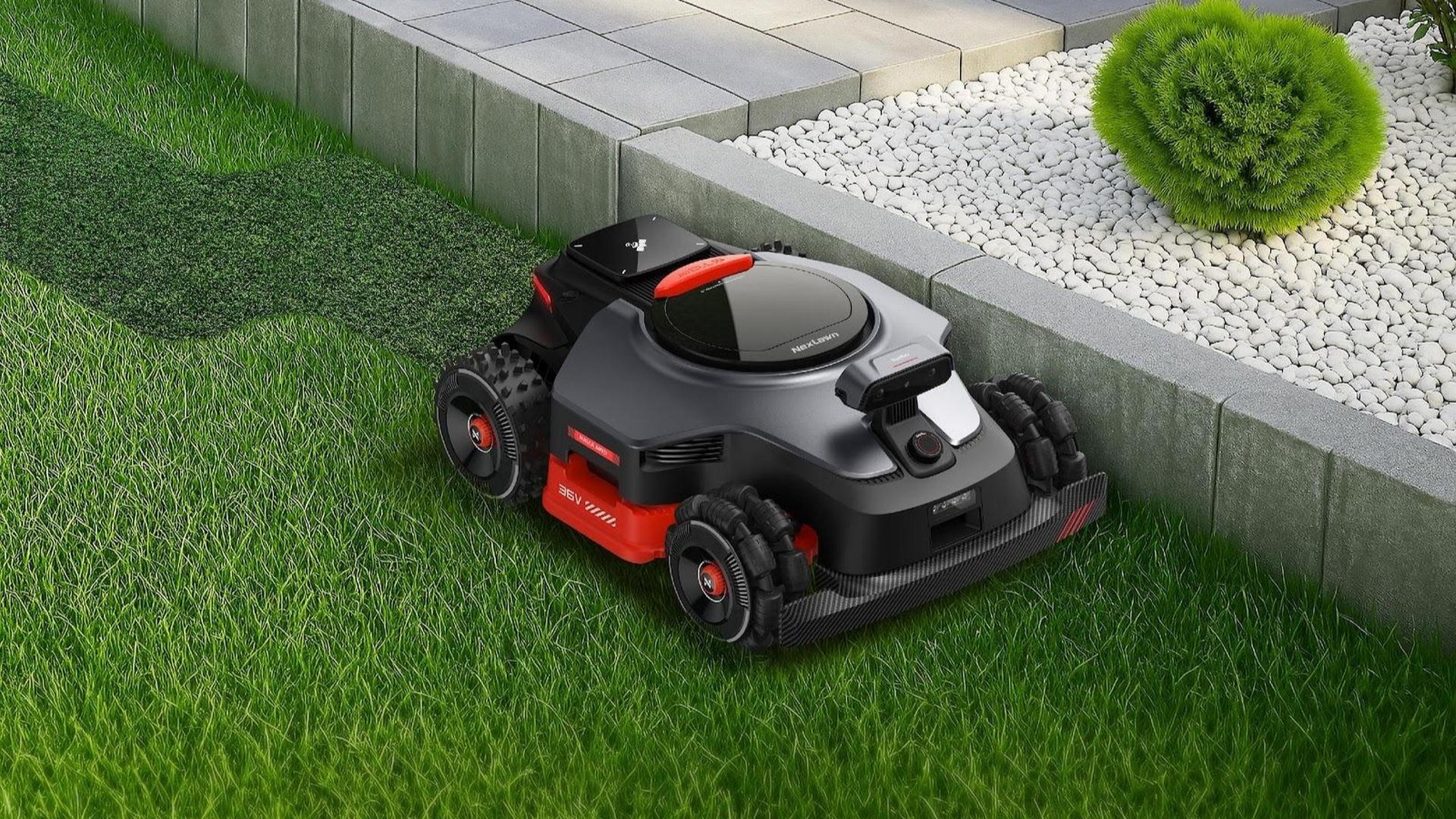
Robot lawn mowers are autonomous, battery-powered machines that cut grass without someone having to push or steer them. You set a mowing schedule, the mower navigates the lawn, trims the grass and returns to its charging station when its battery needs topping up.
The important thing to understand is that a robot mower isn’t simply a smaller version of a conventional mower. It is designed to cut little and often. Rather than waiting until the grass is long and removing a large amount in one session, it repeatedly takes off a tiny amount. The fine clippings are left on the lawn, where they break down rather than being collected in a bag.
How the mower knows where to go, however, varies considerably between models.
How do robot lawn mowers find the edges of your lawn?
There are now four main approaches: boundary wires, GPS/RTK positioning, camera-based vision systems, and LiDAR. However, a lawn mower may use a combination of these apporaches.
Traditional robot mowers, including the entry-level Husqvarna Automower Aspire A4, use a physical boundary wire. The wire is installed around the perimeter of the mowing area and can also be routed around flower beds, trees and other areas you want the mower to avoid. The mower detects the wire and treats it as an invisible boundary.
The drawback is the installation. The wire needs to form a continuous loop back to the charging station, and it can potentially be damaged by gardening tools, animals and the weather. If you change the layout of your garden, you may also need to change the wire.
Newer wire-free models use GPS with RTK (Real-Time Kinematic) positioning. An RTK system uses a fixed reference station to correct satellite positioning data, allowing compatible mowers to determine their position to within centimetres under suitable conditions. You can then create virtual boundaries and mowing areas rather than physically wiring the lawn.
The fixed reference station can either be physically located in your garden, or it can be an internet-based one, with the information sent over the internet. These cloud RTK systems require the robot to have a permanent internet connection via Wi-Fi or mobile. Cloud RTK is becoming more popular as it cuts down on the required hardware.
The Mammotion Luba 3 AWD is one example of this approach. The advantage is flexibility: you can adjust virtual boundaries in the app rather than digging up a perimeter wire. However, satellite-based positioning can be affected by obstacles such as buildings and dense tree cover.

There is also a newer approach: camera-based vision AI. Recent robot mowers are increasingly using cameras to understand their surroundings and identify objects, rather than relying exclusively on a physical boundary or satellite positioning.
Simple camera-based robots can deal with basic gardens by themselves, but aren’t suitable for larger areas. Cameras are also used by many robots to spot and avoid obstacles, and for navigation when an RTK signal is lost (see below for more details).
There’s also a newer navigation system: LiDAR. Using the same kinds of sensors as on robot vacuum cleaners, LiDAR allows for more precise navigation. LiDAR robots can use that technology alone, as with the Ecovacs GOAT O1200, or they can use RTK along with LiDAR for more precise navigation and mapping, as with the Mammotion Luba 3 AWD. Our guide on how LiDAR robot lawnmowers work goes into more detail.

How do robot mowers avoid obstacles?
Obstacle avoidance depends on the model and its sensor package. Robot mowers can use sensors to detect objects in their path and then slow down, stop or change direction.
More advanced systems combine several forms of sensing. LiDAR, for example, uses laser measurements to build an understanding of the mower’s surroundings, while cameras can use computer vision to identify objects and the shape of the environment.
This matters because a robot mower needs to deal with more than just the perimeter. Garden furniture, toys, branches, trees and other objects can all interrupt its route. Even with modern obstacle detection, it is sensible to keep the lawn reasonably clear before running the mower.
How do robot lawn mowers actually cut grass?
This is arguably the biggest difference between a robot mower and a conventional lawn mower.
Robot mowers don’t wait for the grass to become long before cutting it. They make frequent passes and remove only a small amount of grass each time. Those small clippings are mulched and left on the lawn, so there is no grass collection bag to empty. These small clippins help feed the grass automatically.
The result is a mower that is better thought of as maintaining the lawn continuously rather than giving it an occasional major cut. That is also why a robot mower isn’t necessarily a complete replacement for every piece of lawn equipment. Grass around walls and fences can still require a trimmer or edger, while an overgrown lawn may need conventional mowing before the robot can take over regular maintenance.
How do robot lawn mowers charge themselves?
When the battery gets low, the mower automatically navigates back to its charging station. It docks, recharges and can then resume its schedule.
This means you don’t normally need to monitor the battery or manually return the mower to a charger. The exact charging and mowing behaviour varies between models, but automatic docking is a fundamental part of the robot-mower concept.

Do robot lawn mowers work on slopes and in the rain?
They can, but the lawn’s terrain matters. Robot mowers are best suited to relatively smooth, accessible lawns, and maximum slope capability varies significantly between models. Some premium machines are designed for substantially steeper terrain than standard models. For the best hill climbing, and for uneven ground, a robot with All-Wheel Drive (AWD) is best.
Rain is similarly model-dependent. Some robot mowers have rain sensors and can return to the dock when wet weather is detected. Whether you should deliberately run a particular mower in wet grass depends on its design and the manufacturer’s recommendations.
Are robot lawn mowers worth it?
For the right lawn, the biggest benefit is removing routine mowing from your weekend. A robot can work repeatedly to maintain the grass while you handle the jobs it cannot do, such as edging, clearing debris or dealing with particularly awkward areas.
That doesn’t necessarily mean you’ll never touch a lawn mower again. For some gardens, a robot can handle almost all of the regular cutting; for others, you’ll still need occasional manual mowing or trimming.
There are also practical considerations beyond mowing performance. A robot mower is an expensive piece of equipment that spends much of its time outside, so security matters. GPS functionality shouldn’t automatically be treated as a guarantee that a stolen mower can be tracked after it loses power or signal.
Ultimately, how automatic a robot mower feels depends heavily on the garden it is working in. A relatively open, continuous lawn with manageable slopes is much easier for an autonomous mower than a garden divided by paths, tight passages and numerous obstacles. The technology has moved well beyond simple random mowing, but choosing the right navigation system for your garden is still the key to getting the promised hands-off experience.
The post How do robot lawn mowers work? appeared first on The Ambient.