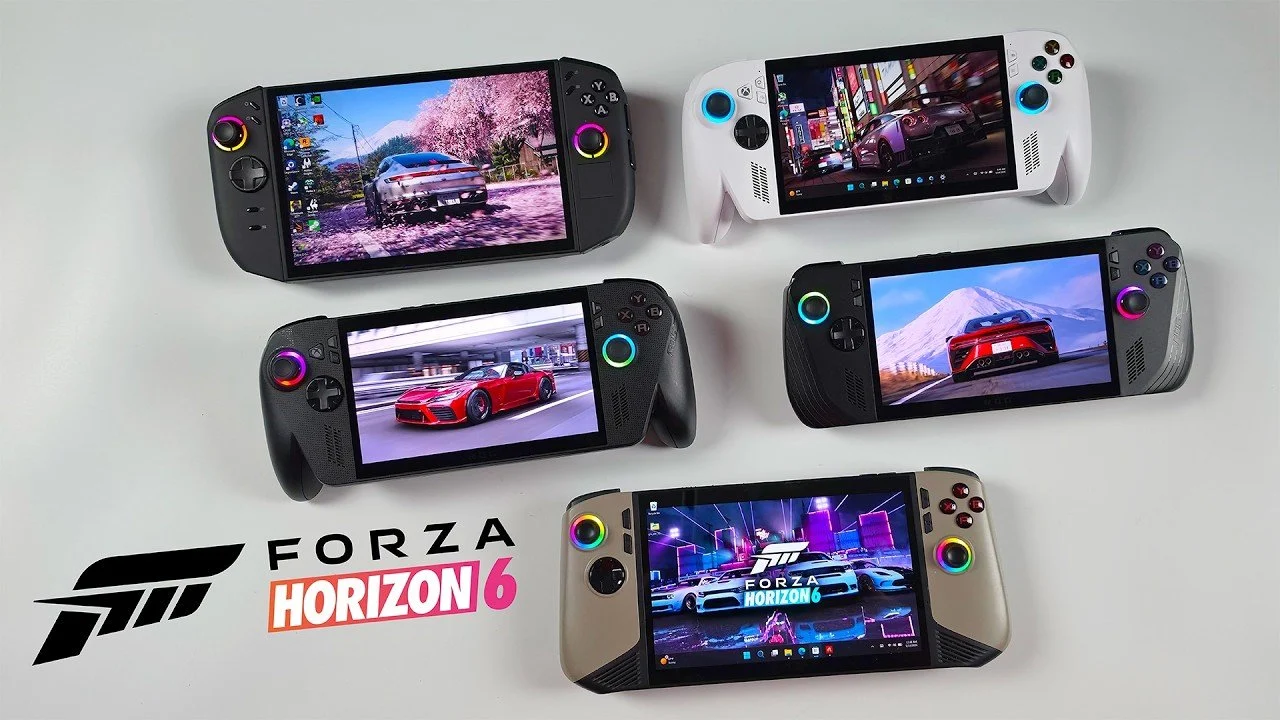
Handheld gaming PCs are pushing boundaries and Forza Horizon 6 serves as a demanding benchmark to evaluate their capabilities. ETA Prime explores how devices like the ROG Ally Z2 Extreme, MSI Claw 8 AI and ROG Ally Z1 Extreme handle this graphically intensive title. By focusing on metrics such as frame rates, TDP levels and upscaling technologies like AMD FSR 3 and Intel XESS, the breakdown highlights the interplay between hardware configurations and performance. For instance, the ROG Ally Z2 Extreme achieves 40-52 FPS at 1080p on medium settings with a 30W TDP, showcasing its ability to deliver smooth gameplay under optimal conditions.
Discover how each device balances power consumption, thermal management and graphical fidelity to meet the demands of modern gaming. You’ll gain insight into the trade-offs between performance and battery life at varying TDP levels, the impact of outdated drivers on devices like the Legion Go 2 and the role of upscaling in enhancing frame rates. Whether you’re considering a handheld for portability or performance, this breakdown provides a clear understanding of what to expect from these systems in real-world gaming scenarios.
Forza Horizon 6
TL;DR Key Takeaways :
- Forza Horizon 6 serves as a benchmark for testing the performance of handheld gaming PCs, including the ROG Ally Z1/Z2 Extreme, MSI Claw 8 AI and Legion Go 2, focusing on frame rates, power consumption and graphical settings.
- The ROG Ally Z2 Extreme outperformed other devices, achieving 40-52 FPS at 1080p on medium settings with a 30W TDP, while the Legion Go 2 struggled due to outdated iGPU drivers.
- Upscaling technologies like AMD FSR 3 and Intel XESS improved frame rates but introduced trade-offs in visual quality, particularly at lower resolutions.
- Graphical settings significantly impacted performance, with medium settings offering the best balance between visuals and frame rates, while high settings provided richer visuals at the cost of performance.
- Power management through TDP levels (17W, 25W, 30W) played a critical role in balancing performance, battery life and heat generation, with 30W unlocking the best performance but requiring active cooling.
Devices Tested
This evaluation focuses on several leading Windows-based handheld gaming PCs, each equipped with unique hardware configurations:
- ROG Ally Z1 Extreme and Z2 Extreme: These devices feature AMD’s high-performance APUs, designed to cater to gaming enthusiasts seeking portable power.
- MSI Claw 8 AI: Powered by Intel’s 258V integrated graphics, this device offers a competitive alternative to AMD-based systems, emphasizing efficiency and performance.
- Legion Go 2: While its hardware is comparable to the Z2 Extreme, its performance is hindered by outdated iGPU drivers, limiting its potential.
Each device was rigorously tested under various configurations to assess its ability to deliver smooth and immersive gameplay in Forza Horizon 6.
Performance Metrics
Performance was evaluated across three Thermal Design Power (TDP) levels, 17W, 25W and 30W, at resolutions of 720p and 1080p. Graphical settings were adjusted to low, medium and high to measure their impact on frame rates and overall gameplay quality. Key findings include:
- ROG Ally Z2 Extreme: Demonstrated the best performance, achieving 40-52 FPS at 1080p on medium settings with a 30W TDP. This device consistently delivered a smooth gaming experience.
- MSI Claw 8 AI: Performed admirably, particularly at higher TDP levels, but faced thermal challenges during prolonged gaming sessions.
- Legion Go 2: Struggled to keep up due to outdated drivers, averaging 22-35 FPS on comparable settings, highlighting the need for software updates.
- ROG Ally Z1 Extreme: Delivered playable frame rates at lower settings but fell short at 1080p on higher graphical presets, making it less suitable for demanding configurations.
These results emphasize the critical role of TDP in balancing performance, power consumption and thermal management, particularly in handheld gaming scenarios.

Become an expert in ROG Ally with the help of our in-depth articles and helpful guides.
Upscaling Technologies
To enhance performance without sacrificing visual quality, upscaling technologies like AMD FSR 3 and Intel XESS were tested. These tools aim to boost frame rates while maintaining acceptable graphical fidelity.
- AMD FSR 3: Provided a significant FPS boost on AMD-powered devices like the ROG Ally series. However, occasional visual artifacts were observed, particularly at lower resolutions.
- Intel XESS: Delivered smoother performance on the MSI Claw 8 AI but struggled to match the visual fidelity offered by FSR 3, especially at higher graphical settings.
While these upscaling technologies improved gameplay fluidity, the trade-offs in visual quality were more noticeable at 720p than at 1080p, making them more suitable for higher resolutions.
Graphical Settings and Frame Rates
Graphical settings played a pivotal role in determining frame rates and overall gameplay quality. Higher settings offered enhanced visuals but came at the cost of performance, particularly on less powerful devices.
- High Settings: Delivered 30-40 FPS on the ROG Ally Z2 Extreme and MSI Claw 8 AI at 1080p with a 30W TDP, providing a visually rich experience.
- Medium Settings: Struck a balance between visuals and performance, achieving 35-50 FPS across most devices, making it the optimal choice for many players.
- Low Settings: Ensured smooth gameplay at 720p, with frame rates exceeding 50 FPS on most configurations, ideal for extended gaming sessions.
Achieving a consistent 60 FPS at 1080p was not feasible in handheld mode but became possible in docked mode with upscaling technologies enabled, showcasing the potential of these devices when paired with external displays.
Power Management and TDP
Power management is a crucial factor for handheld gaming PCs, as TDP levels directly influence performance, battery life and heat generation. The balance between these elements determines the overall usability of the device.
- 17W TDP: Optimized for battery life but limited performance, with frame rates dropping below 30 FPS on high settings, making it suitable for less demanding scenarios.
- 25W TDP: Offered a balanced approach, delivering playable frame rates without excessive heat generation, making it ideal for most gaming sessions.
- 30W TDP: Unlocked the full potential of devices like the ROG Ally Z2 Extreme, delivering the best performance but requiring active cooling to manage heat effectively.
Efficient power management is essential for making sure a seamless gaming experience, particularly during extended sessions where battery life and thermal performance are critical.
Future Potential
The performance of these handheld gaming PCs is expected to improve with future updates. GPU driver optimizations could address the Legion Go 2’s underperformance and further enhance the capabilities of the ROG Ally and MSI Claw 8 AI. Additionally, advancements in upscaling technologies like AMD FSR and Intel XESS may offer better visual quality and frame rates in future iterations. These developments could significantly enhance the overall gaming experience, making handheld gaming an increasingly viable option for enthusiasts seeking portability without compromising performance.
Media Credit: ETA PRIME
Disclosure: Some of our articles include affiliate links. If you buy something through one of these links, techschimp Gadgets may earn an affiliate commission. Learn about our Disclosure Policy.