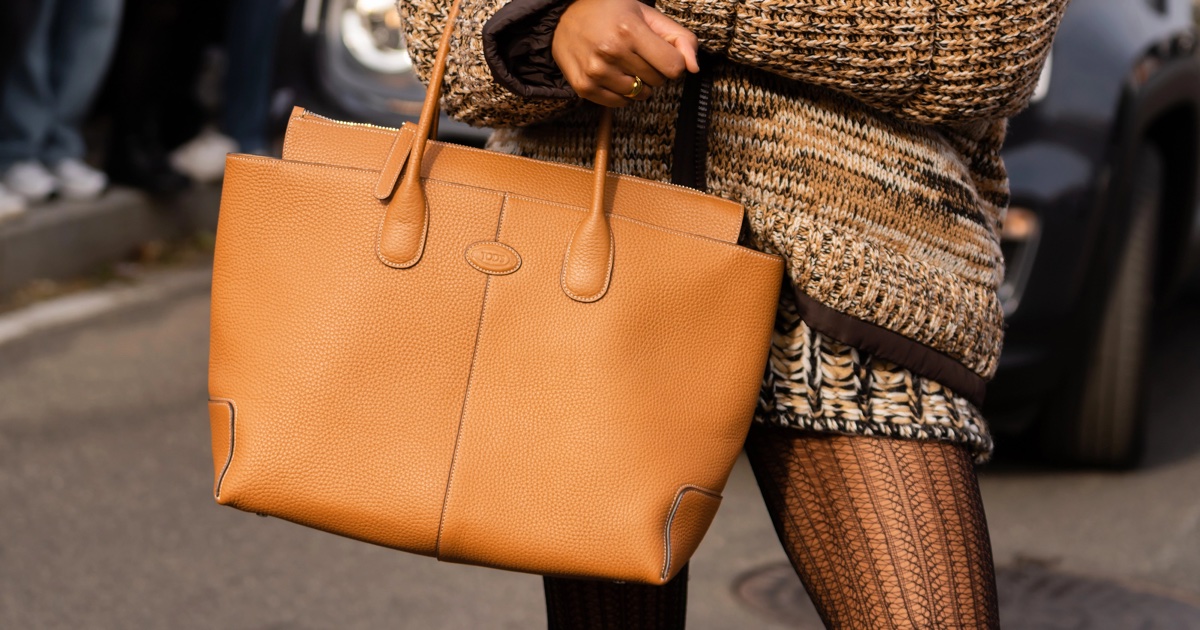
A Goyard St. Louis tote in coated canvas runs close to $2,000. A tote bag handed out free at a museum members’ preview costs the museum about $4 to produce. Cut a rectangle of fabric, add two handles, stitch a gusset for depth, and both objects exist. The proportions land within an inch of each other.
What separates them sits entirely outside the bag, in the stamped logo, the waitlist, the story about where the canvas was woven.
The tote is fashion’s great equalizer because it strips the discipline down to its cheapest possible unit, then charges wildly different amounts for that same unit depending on who prints a name on it. Few pieces among this season’s accessories pull off that split as cleanly as the tote does.
Two Ends of the Same Bag

Goyard’s St. Louis PM, a coated canvas tote with leather trim, now retails between $1,890 and $1,960 in the United States, up from roughly $1,200 to $1,500 five years ago. The design stayed the same.
What changed is scarcity. Goyard sells only through its own boutiques, skips e-commerce entirely, and lets a waitlist do the marketing a discount code never could. Marc Jacobs took the opposite route in 2019 with an item literally named The Tote Bag, a plain canvas rectangle stamped with the brand name in block letters, priced under $200.
By 2023, it was everywhere in off-duty street style, worn by Gigi Hadid and Kendall Jenner and unboxed across TikTok until the block letters became a trend of their own, proof that a logo on canvas can generate as much desire as a logo on calfskin.
Both bags do the identical job of holding a laptop and a water bottle, and both function as walking advertisements, one financed by a customer who paid close to $2,000 for the privilege, the other financed by a customer who paid $200 and still did unpaid promotional work every time she stepped onto a subway platform.
The free tote runs the same math from the opposite direction. Branded tote bags handed out at sample sales, product launches, and fashion week showrooms exist purely as marketing, and attendees compete for them anyway, because scarcity works even at a price of zero.
A limited-run merch tote from a single fashion week or a museum gift shop turns into a collectible the moment the drop ends. Retailers understood this math before it had a name. A free tote bundled with a $150 purchase raises average order value more reliably than a discount code, because it turns a receipt into an item a customer will use in public for years.
Whether the price is $2,000 or nothing, the tote’s real value sits outside the bag itself, in the cheapest, most durable billboard fashion has ever designed, one people pay for the right to wear.
Green Signal, Real Impact

The tote’s origin story is environmental. Cotton totes entered mainstream fashion in the 2000s as the answer to plastic bag bans, marketed on the promise that reusable meant responsible. The math complicates that promise.
A cotton tote’s production footprint runs far higher than a plastic bag’s, and a 2018 Danish government study found a plain cotton tote needs roughly 7,100 uses to offset its manufacturing impact against a single-use plastic bag used once, while the United Nations Environment Programme puts the break-even point closer to 50 to 150 uses depending on the cotton and the comparison method.
Most totes gathering dust in a closet after three trips to the farmers market fall well short of justifying their carbon cost. Brands that name the tradeoff, organic cotton sourcing, recycled canvas, a stated number of wears needed to break even, keep more credibility than brands that print “sustainable” on the handle and stop there.
82% of consumers want a brand’s values to match their own, and a tote is often the first place that alignment gets tested, since it is the item a shopper displays daily instead of the item folded into a drawer. The grocery-run canvas, the office leather tote, and the festival collectible each signal a different value system through the same silhouette.
The Difference Between a Keeper and a Donation

Some totes stay in weekly rotation for a decade. Others reach the donation pile within a month, and the difference rarely comes down to the brand name stamped on the front.
Straps set too close together dig into a shoulder within one commute, while straps spaced to actual shoulder width disappear during wear. A logo printed at true scale stays a detail; a logo blown up past a few inches turns the bag into a billboard nobody asked to be.
A base panel with no structure collapses the moment a laptop and a water bottle go in together, while a stiffened bottom panel or an interior gusset holds the shape empty or full.
Canvas that ages into soft creasing gets more use over time; canvas treated with a coating that cracks after a few rain-soaked commutes gets retired fast. The tote that survives is rarely the most expensive one. It is the one that solved its proportions correctly on the first try.
The Bottom Line

Runway trends cycle every season, and silhouettes shift within a year of their debut. The tote outlives all of it. Its shape settled decades ago and stayed there, apart from fashion’s churn, which is why fashion keeps needing it.