Verdict
Reolink’s Solar Floodlight Cam strips outdoor security back to something far more accessible, combining an integrated solar-powered design, a built-in battery, and a floodlight camera into a single unit that removes wiring, subscription requirements, and most of the usual installation hassle.
It doesn’t aim to compete with Reolink’s higher-end Elite Floodlight in terms of resolution or sheer lighting punch, but it delivers a solid 2K camera, a capable 1000-lumen floodlight, and a solar system that realistically keeps the device running even through inconsistent sunlight.
If you want straightforward, affordable outdoor security without ongoing fees, this is one of the easiest recommendations in Reolink’s lineup.
Reolink has been steadily refining its security camera range, and the Solar Floodlight Cam feels aimed squarely at users who want protection without added complexity or ongoing costs.
Compared to something like the Elite Floodlight WiFi, which pushes higher resolution, brighter lighting, and hardwired installation, this model takes a far more approachable direction, and at a noticeably lower price point (well under $100 right now).
With its integrated solar panel, internal battery, and compact floodlight design, it can be installed in locations where running power simply isn’t practical.
It still carries Reolink’s familiar philosophy of local storage and on-device intelligence, but in a package that is clearly designed for mainstream use.
Read on for my full Reolink Solar Floodlight Cam review.
Reolink’s design language has been gradually shifting away from its earlier industrial aesthetic, and this model continues that trend. It still looks like a security device first, but it feels less utilitarian and more like a purpose-built outdoor product.
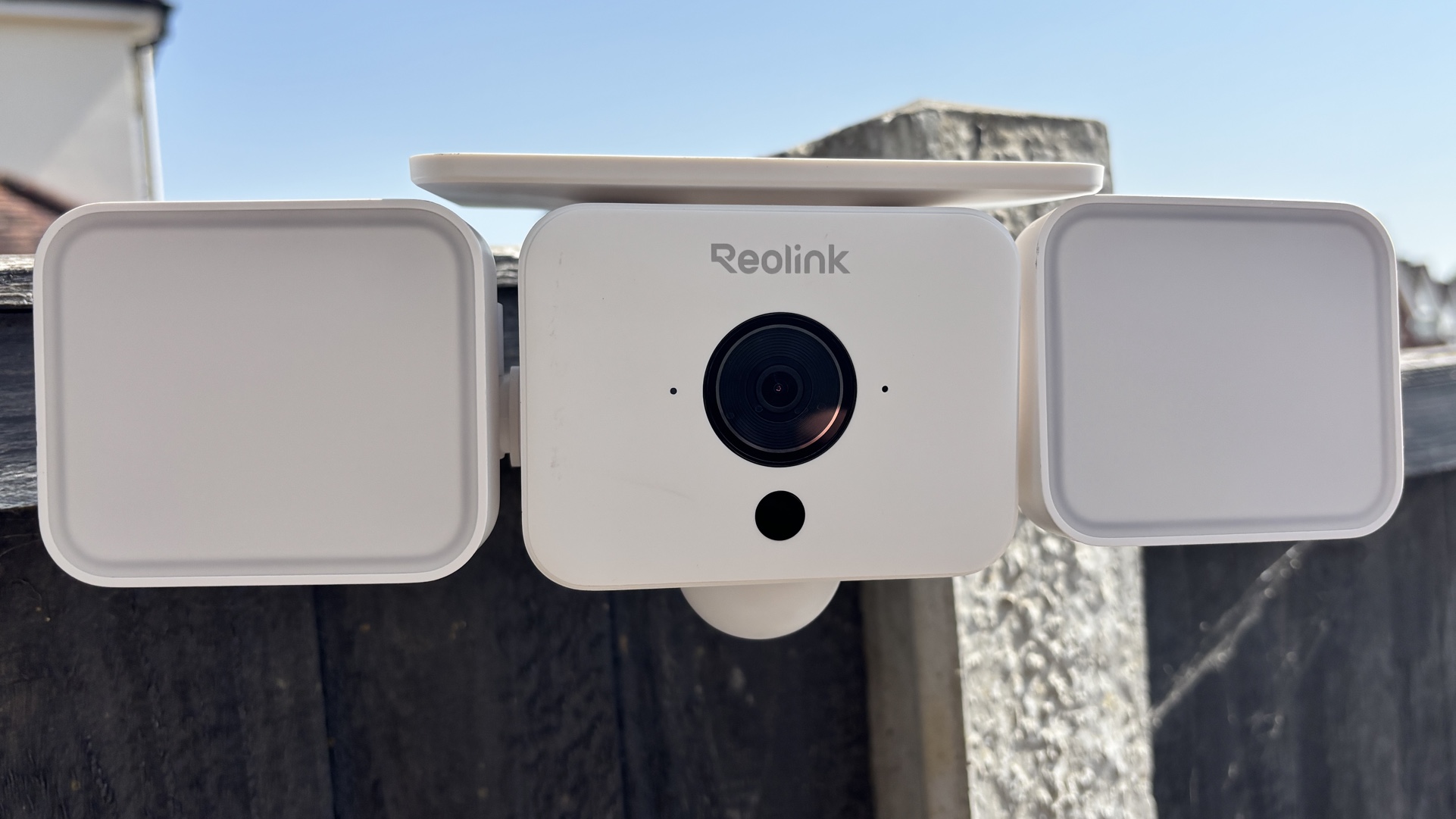
The unit itself is compact and boxy, with dual adjustable floodlights positioned on either side of the central camera lens.
Beneath the lens sits a small infrared LED, while the underside houses the PIR sensor, speaker grille, microSD slot, and a concealed power button.
Storage is handled through a microSD slot protected by a weather flap, along with a separate sealed cover for the USB-C power input. Unlike some higher-end Reolink cameras, the card slot is not physically secured with screws, which leaves it exposed if the device is removed.
Inside the box, you get the camera unit, USB-C cable, mounting bracket, screws and wall plugs, plus a small installation tool. A guide sticker helps with positioning, and setup is fast enough that the entire mounting process can be completed in just a few minutes.
Once the bracket is fixed, the camera attaches via a screw-in mount and can be angled using a ball-and-socket joint for positioning flexibility.
Setup follows Reolink’s familiar pairing process. You scan the QR code on the device, then use the camera to scan a second code generated in the app. It’s quick, straightforward, and usually takes only a couple of minutes from start to finish.
No account is required unless you want cloud storage or integration with platforms like Amazon Alexa or Google Home.
Connectivity includes both 2.4GHz and 5GHz Wi-Fi bands, along with Wi-Fi 6 support, which helps maintain a more stable stream if your outdoor network coverage is strong enough.
The integrated solar panel is built directly into the top of the unit, keeping the design clean and self-contained. It removes the need for external panels or wiring runs, although it does come with a limitation: you can’t adjust its angle for optimal sun exposure. A secondary solar panel can still be connected if needed.
Once installed, the camera runs through the Reolink app, which remains one of the most feature-rich platforms in the security camera space, even if it can feel a bit dense at times.
The upside of that complexity is control. Nearly every aspect of detection, recording, and alerts can be adjusted to suit your environment.
Out of the box, the system works with minimal configuration, but the real value comes when you start refining settings.
Detection can be filtered between people, vehicles, and animals, which significantly reduces unnecessary alerts. You can also create schedules so that different detection types trigger at different times of day, depending on your needs.
Alerts are delivered through push notifications, but these can become frequent unless carefully tuned. Object-based detection helps manage this by narrowing triggers to specific categories such as people, pets, or cars.
Local storage is handled via microSD card support, with capacity up to 512GB. There are no mandatory subscription fees to access recordings, and footage can also be routed through Reolink Home Hub or an NVR system for expanded storage options.
Cloud storage is optional, with a free tier offering limited capacity and paid plans that scale up depending on storage size and retention length. Pricing remains notably lower than competitors such as Ring or Nest, with 1GB of free storage (7-days of history), and then paid options: $3.49, $6.99 or $10.49 monthly.
The AI detection system performs reliably in distinguishing between motion types. While not flawless, it does a good job of reducing unnecessary alerts that often plague entry-level cameras.
Recorded footage can be filtered within the app by event type, and clips can be saved directly to a phone. The interface can even highlight detected people, vehicles, and animals with visual overlays for easier review.
One important detail is download quality. By default, the app may save lower-quality “fluent” clips unless manually adjusted to full resolution, which is something worth changing during setup. Bitrate controls are also available for more advanced tuning.
Video management is more rigid than some users might expect. Individual clip deletion isn’t supported, meaning you either format the storage card or allow the system to overwrite older footage automatically.
Two-way audio is included, along with a built-in 110dB siren. Both can be triggered manually or automatically via detection events. The speaker output is functional but slightly thin, which is typical for this category of device.
Performance is solid, though clearly positioned below Reolink’s flagship cameras, which is expected given the price and power setup.
The 2K resolution delivers clear enough detail for everyday security use. Faces, vehicles, and general movement are all easily identifiable in daylight, though it does not reach the sharpness levels of Reolink’s higher-end 4K models.
Night performance depends heavily on lighting conditions. With the floodlights active, footage switches into full-color night vision, which provides strong clarity and usable detail for identification. Without illumination, the camera reverts to black-and-white infrared, which is functional but less detailed.
There is a slight delay between motion detection and floodlight activation, which results in a brief period of infrared-only capture before full lighting engages. It’s noticeable but not critical in real-world use.
The floodlights output 1000 lumens, which is enough to illuminate driveways, entry points, and garden areas effectively. It doesn’t match the intensity of higher-end Reolink floodlight systems, but it still provides strong deterrent lighting rather than ambient illumination.
Solar performance stands out as one of the most impressive aspects of the device. Reolink’s SolarEase system is designed to improve efficiency, with claims of up to 26 percent conversion efficiency and the ability to charge even in suboptimal conditions such as cloud cover or partial shade.
In testing, a charge increase from 38% percent to 61% was achieved in roughly three hours of mixed UK sunlight. After a few consistently sunny days, the battery remained close to full capacity for extended periods.
Overnight drain brought levels down to around 40% but the system consistently recovered quickly during daylight. Reolink’s estimate of up to three months of operation on a full charge appears realistic under low-activity conditions with reasonable solar exposure.
The Solar Floodlight Cam fits neatly into Reolink’s ecosystem as a more accessible, lower-maintenance alternative to its higher-spec floodlight cameras.
It is not designed to compete on resolution or raw output. Instead, it prioritizes ease of installation, solar independence, and a genuinely subscription-free experience.
There are trade-offs, particularly around resolution limits, the unprotected storage slot, and the fixed solar panel design. However, those compromises are balanced by a system that is simple to install, easy to live with, and capable of running independently for long periods.
For users who want dependable outdoor security without wiring, subscriptions, or ongoing complexity, this is one of Reolink’s most practical offerings.
When we publish our reviews, you can rest assured that they are the result of “living with” long term tests.
Smart security cameras usually live within an ecosystem, or a range of products that – supposedly – all work in harmony. Therefore, it’s impossible to use a security camera for a week and deliver a verdict.
Because we’re testing smart home kit all day, everyday, we know what matters and how a particular camera compares to alternatives that you might also be considering.
Our reviews are comprehensive, objective and fair and, of course, we are never paid directly to review a device.
Read our guide on our review process for smart security cameras to learn more.