Verdict
The Ikea Varmblixt smart donut lamp takes a design people already love and adds smart control without turning it into something it’s not. It still reads as a glowing piece of decor first, gadget second, which is exactly why it works. You won’t find advanced lighting effects or the polish of high-end rivals like Govee or Hue, and it’s nowhere near bright enough to light a full room. But that’s not really the point. This is about setting a mood, and at this price, it does a solid job… a few connection quirks aside.
A few years after its breakout moment, the Varmblixt donut is back, this time with smart home chops, and part of Ikea’s broader shift toward Matter over Thread.
The original version stood out for its bold, glowing orange ring that looked more like an art piece than a lamp.
This updated model tones that down visually with a frosted white finish, while adding color control, dimming, and cross-platform compatibility under the hood.
It’s the same iconic shape, just with a bit more brains behind it. Read on for a full review
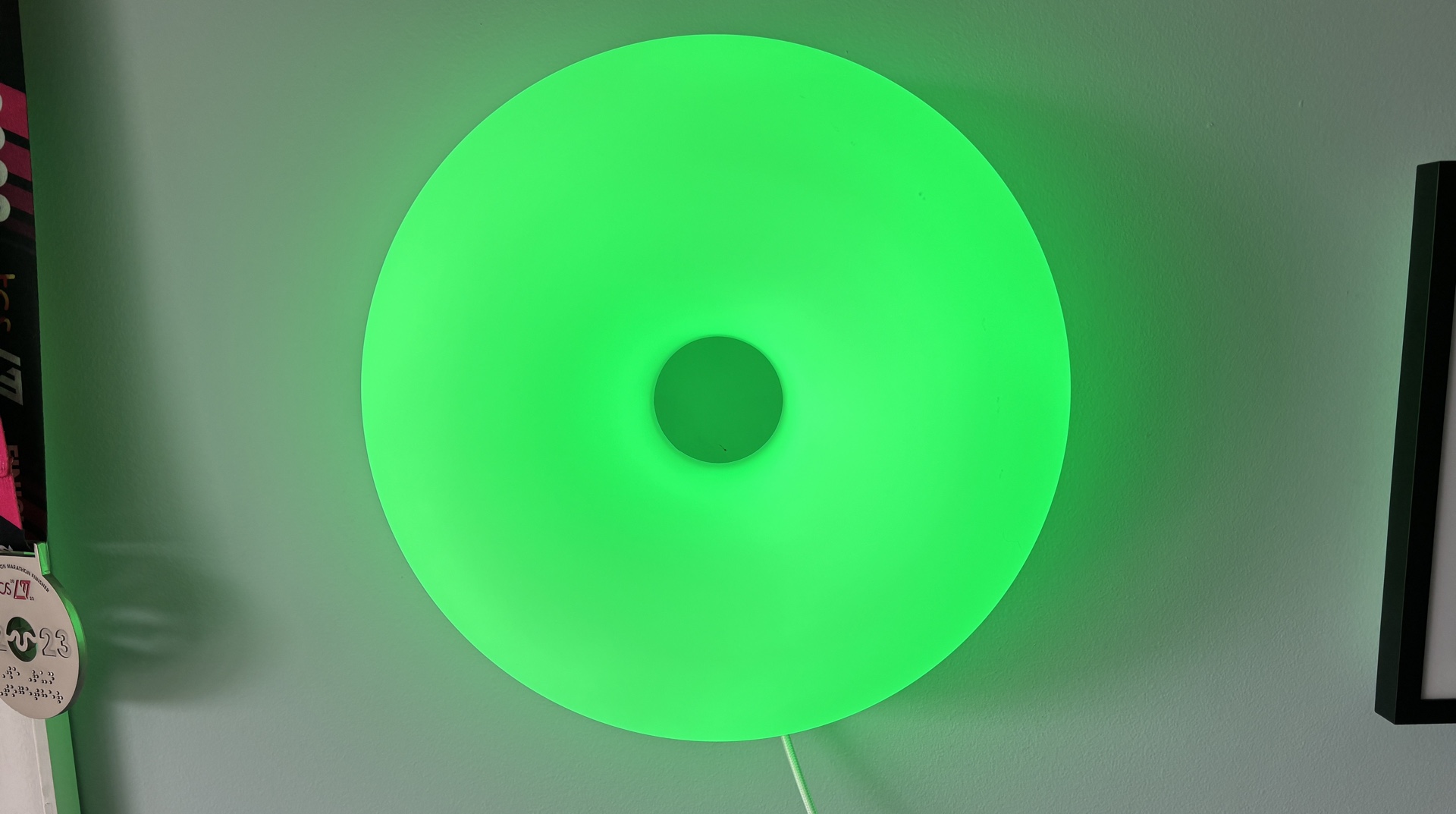
At a glance, not much has changed, and that’s a good thing. It’s still a chunky circular form that grabs attention, only now with a softer, matte glass finish instead of that bright orange gloss.
You can still dial in that warm orange glow (or plenty of other colors), but when it’s off, it blends in far more easily.
Size-wise, it’s not subtle. At around 12 inches across, it has real presence. Mounted on a wall, it feels intentional, almost like a light-based art piece. When sitting on a table or sideboard, it can feel a bit oversized.
It’s technically designed for both, but wall mounting looks better, in my opinion at least.
Setup is about as easy as it gets. One screw holds the backplate in place, and the glass ring clips over it. Done. If you’re placing it on furniture instead, there’s nothing to install at all.
The light source itself sits in the backplate – a short circular strip – while the glass acts purely as a diffuser.
A fabric-style power cable runs from the bottom, which looks nicer than standard plastic cords, and there’s a physical on/off switch tucked underneath. It does need to stay plugged in, so you’ll want to think about cable placement.
That constant power also means it can act as a Thread mesh extender, helping strengthen your mesh network.
The lamp comes with an Ikea Bilresa remote, which is actually a separate Matter device. That’s a nice bit of flexibility, but it does introduce some setup quirks.
Out of the box, the remote isn’t paired to the lamp. Pairing is simple enough (and interestingly uses Zigbee behind the scenes), but if you later add the lamp to a Matter setup, that pairing gets wiped. That’s not exactly intuitive.
In its basic setup, the remote handles the essentials; cycling through preset colors, adjusting brightness, and switching the lamp on or off.
Once you bring it into a Matter ecosystem, that remote becomes far more useful. You can map different button presses to control not just the lamp, but other smart home devices too; think lights, blinds, heating, whatever you’ve got connected.
The lamp itself uses Matter over Thread, so it works with platforms like Apple Home, Amazon Alexa, and Google Home, as long as you’ve got a compatible controller and Thread border router.
Those aren’t hard to find as they’re built into a bunch of popular devices such as Apple TV, HomePod, Echo speakers, Nest devices, even some Samsung TVs and appliances can handle that role.
You can also use Ikea’s Dirigera hub and app, but you’re not unlocking a deeper feature set by doing so. Control is fairly straightforward no matter which route you take.
There’s no advanced color blending or animated effects here. This is more straightforward smart lighting; pick a color, adjust brightness, tweak white tones, and that’s about it.
In day-to-day use, it does what you’d expect, albeit with a few caveats.
Color reproduction is solid. There’s nothing overly punchy or artificial, just well-balanced tones across the range. Whites are especially nice, shifting smoothly from cooler daylight hues to warmer, more ambient shades. It also plays nicely with adaptive lighting in Apple Home.
Brightness is the limiting factor. At 180 lumens, this is firmly in accent lighting territory. It adds atmosphere, but it’s not lighting up your living room.
When connected, responsiveness is good. Commands register quickly, and transitions between colors are smooth.
That said, connectivity wasn’t flawless. There were occasional moments where the lamp dropped offline briefly before reconnecting. Not constant, but enough to notice.
This lamp sits right in the middle of Ikea’s move away from Zigbee and toward a Matter-first approach.
Setup is straightforward if you’re familiar with Matter. Scan the code, choose your platform, and you’re in. Because of Matter’s multi-admin feature, so you can control it across multiple ecosystems at once.
In testing, it worked across Apple Home, Alexa, and Home Assistant without much friction.
What stands out is how flexible the experience is. You can fully integrate it into a smart home setup, or just stick with the included remote and skip apps altogether.
A lot of people will probably take that second route. It works perfectly well as a “smart enough” lamp without needing deeper integration.
The Varmblixt smart donut doesn’t try to go toe-to-toe with feature-heavy smart lighting systems. and that’s probably for the best.
It sticks to what made the original popular: a bold design that doubles as a light source. The smart features add convenience without getting in the way.
If you want high brightness and advanced effects, brands like Philips Hue or Govee still lead the way. This isn’t aiming for that.
But as a decorative smart lamp that looks great on a wall, adds a bit of atmosphere, and plays nicely with modern smart home platforms, it’s easy to recommend.
When we publish our reviews, you can rest assured that they are the result of “living with” long term tests.
Smart lights usually live within an ecosystem, or a range of products that – supposedly – all work in harmony. Therefore, it’s impossible to use a connected light for a week and deliver a verdict.
Because we’re testing smart home kit all day, everyday, we know what matters and how a particular light compares to alternatives that you might also be considering.
Our reviews are comprehensive, objective and fair and, of course, we are never paid directly to review a device.
Read our guide on how we test smart lights to learn more.