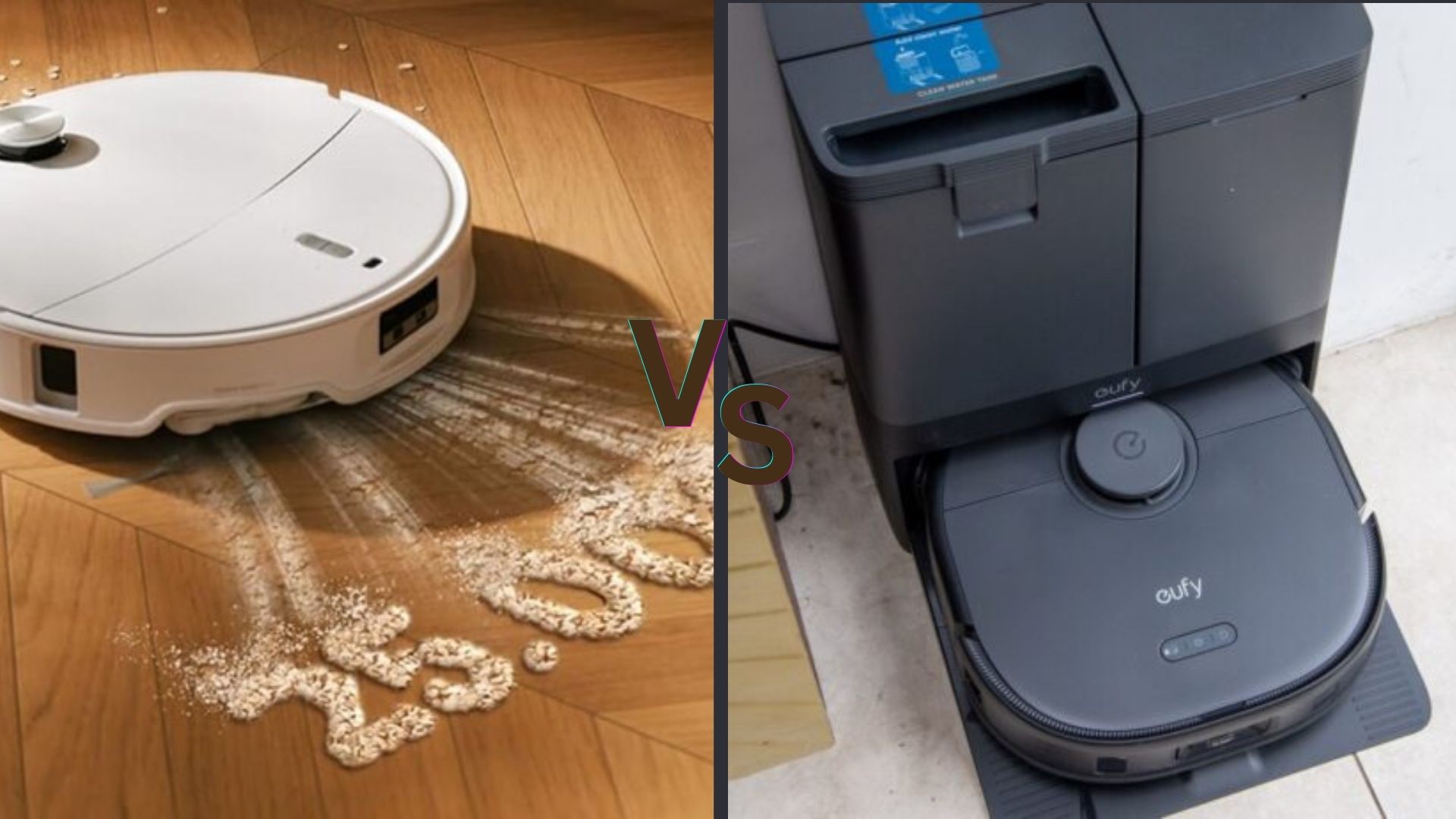
Eufy and Roborock take slightly different approaches to robot vacuums. Eufy has built much of its reputation around delivering plenty of features without pushing prices too high, while Roborock has established itself as a flagship brand that introduces new features.
That makes choosing between them less straightforward than simply asking which brand makes the best robot vacuum. Eufy has some seriously capable machines, including newer models such as the Omni E28, while Roborock’s current range stretches from relatively affordable Q-series models to premium machines such as the Qrevo and Saros ranges.
The good news is that both brands now cover most budgets and cleaning requirements . We’ve tested both systems to see how they compare, and help you realize what matters most in your home.
Eufy’s current lineup runs from budget models to premium machines, with the Omni E28 sitting towards the upper end at £899/$1,199 in the UK. Roborock, meanwhile, has models ranging from the budget end of its Q series through to expensive flagship machines.
The difference is particularly interesting in the mid-range, where both companies are packing features that would have been reserved for much more expensive robots a few years ago.
Roborock’s Qrevo S Pro is a good example. It currently sits at £479.99/$648.19 on Roborock’s UK store, with 18,500Pa suction, dual liftable spinning mops, high-temperature mop washing and warm-air drying.
Eufy has taken a similar approach with models such as the X10 Pro Omni. It offers 8,000Pa suction, AI obstacle avoidance, laser navigation and an all-in-one station, and Eufy’s UK store currently lists it from £599/$799.
At the higher end of the market, the specifications become even more interesting. Eufy’s Omni E28 offers 20,000Pa suction and a HydroJet roller system, while Roborock’s Qrevo Curv 2 Flow also reaches 20,000Pa and uses a wide self-cleaning roller mop. The latter is currently listed at $799.99 in the US.
Actual quality will depend on the model that you buy. Get the Saros 20 and you get a massive 36,000Pa of suction power, the company’s most advanced brushes, and the ultra-slim chassis that lets it slide under low furniture. At the high-end, then, Roborock generally has the advantage.
Eufy isn’t far behind, with the Omni S2 offering 30,000Pa of suction power, and generally doing as well in open space. It, too is a powerful cleaner from what we’ve seen.
Individual reviews are what counts, as you need to look beyond the Pa figure when comparing the two brands. A robot advertising 18,500Pa isn’t automatically going to vacuum better than one with a lower number. Modern anti-tangle systems and increasingly complex brush designs can involve trade-offs, particularly on carpets.
The newer models also make direct brand comparisons harder than they used to be. A budget Eufy and a premium Roborock can have completely different strengths, just as a current Eufy flagship can outperform an older Roborock model in some areas.
Eufy was the first company we’ve seen to use a roller mop, with the newer Omni models use HydroJet roller-mop technology that continuously washes the roller as it cleans. Mopping pads get saturated with dirt, so can drag stains; plus, these robots need to go back to the dock more often to clean their pads.
Eufy’s system particularly appealing if you have mostly hard flooring and want the robot to deal with dried-on marks and everyday dirt.
Roborock’s mopping systems are also very capable, with most using mopping pads. Years of advancements have show that Roborock’s newer machines can clean stubborn stains well, and it can spot and detect areas that need special attention. Again, it’s important to read individual reviews, as there are variances in the product range.
However, there is one area where Roborock generally has an advantage: mixed flooring environments. Both Eufy’s and Roborock’s robots can lift their mop pads/roller when carpet is detected (typically up to 10cm), which lets them pass over short pile carpet.
However, Roborock’s higher-end products, such as the Saros range, can drop their mop pads off when vacuuming only, so they can move over deeper pile carpets without damaging them. For complex environments, Roborock’s flagship models are better.
Both companies now offer LiDAR-based mapping on a range of models, and both have added increasingly sophisticated obstacle detection, with camera-based AI detection.
Roborock has historically been particularly good at mapping and route planning. Its robots generally feel methodical about where they go and how they cover a room, while the app gives you a large amount of control over maps, rooms and cleaning zones.
Eufy is not far behind, and some of its newer robots are particularly good at avoiding objects. Independent testing of the Eufy X10 Pro Omni found its hazard avoidance to be significantly better than the Roborock Qrevo S in that particular comparison.
That is important for anyone who doesn’t live in a perfectly tidy home. A robot that can recognise a cable, shoe or other object and go around it can be more useful than one that technically has a more sophisticated navigation system but keeps getting itself into trouble. Roborock still gets the edge for navigation overall, but Eufy is closing the gap and can actually be the better choice if obstacle avoidance is your biggest concern.
Roborock’s app is one of the strongest parts of its ecosystem. It gives you detailed maps, room controls, schedules, no-go zones and plenty of options for deciding exactly how and where the robot cleans. Meanwhile, Eufy’s app is perfectly usable and gives you the important controls, including mapping, room selection, schedules and no-go areas. It just doesn’t have quite the same level of polish as Roborock’s software.
That difference becomes more noticeable as you move up the range. The more capable the robot becomes, the more settings there are to manage, and a well-designed app becomes increasingly important. Moreover, both brands also support voice control, although the exact experience depends on the robot and the smart home platform you’re using.
If you’re the sort of person who sets a schedule once and lets the robot get on with it, the difference between the two apps probably isn’t enough to influence your buying decision. If you regularly create zones, change cleaning settings or manage a complicated floor plan, Roborock’s app is the better reason to spend more.
Moreover, both Eufy and Roborock have active user communities, and reliability concerns come up for both brands. Roborock owners have raised questions around the durability of moving parts such as lifting mechanisms, while Eufy users have discussed app and customer-support issues.
But it is worth remembering that newer models can change the equation. A complaint about an older Eufy or Roborock model doesn’t necessarily tell you how a current-generation robot will perform. The more useful approach is to look at the warranty available in your market, replacement parts, support and the complexity of the particular model you’re buying.
If you want the most polished robot vacuum experience, Roborock is the one to get. It has the edge in navigation and mapping, a more refined app, and consistently strong cleaning and mopping performance across its range. Eufy offers excellent value and some very capable newer models, but Roborock feels like the more complete package.
Utlimately, both companies produce some very good robots, so read our reviews to find the one that best suits you.