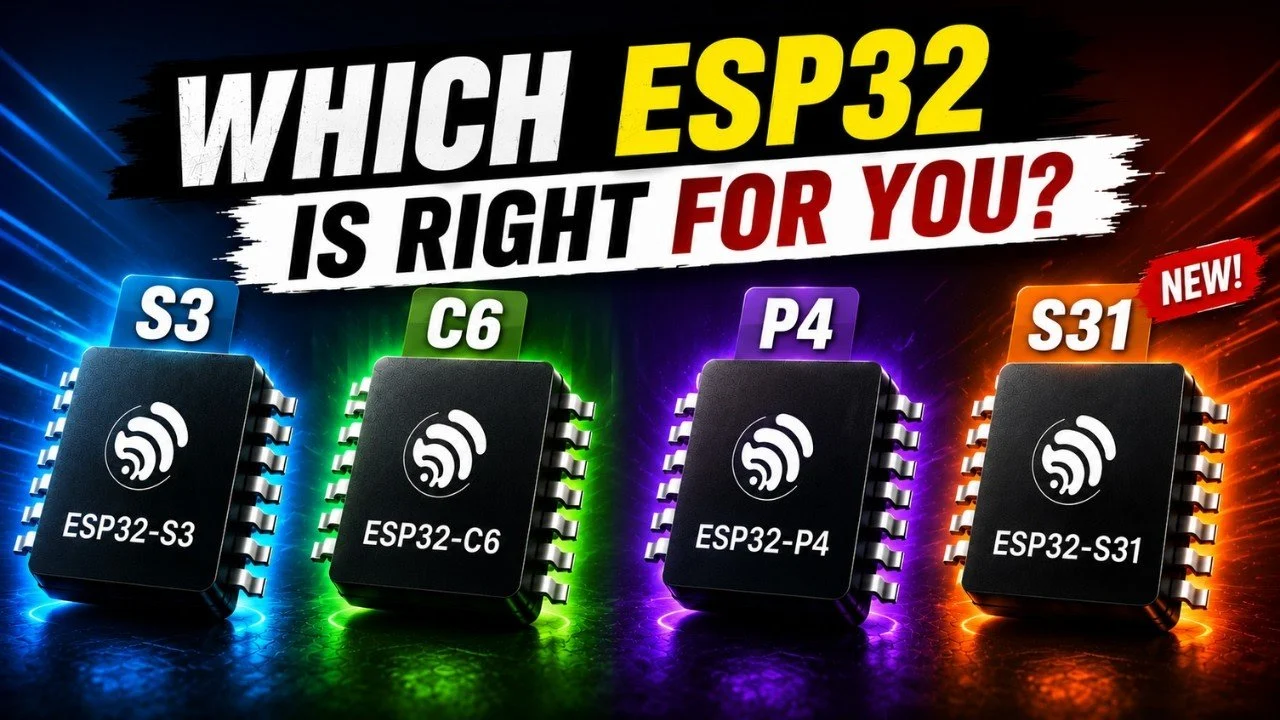
The ESP32 family of microcontrollers has become a cornerstone in IoT, smart home and industrial applications, offering tailored solutions for diverse needs. In this deep dive, ToP Projects Compilation explores four prominent ESP32 models, S3, C6, P4 and S31, each designed with distinct capabilities. For example, the ESP32 S3 features a dual-core processor, Wi-Fi 4 and Bluetooth 5.0, making it a strong candidate for multimedia-rich projects like smart displays or voice assistants. By examining their processing power, connectivity options and security features, this guide highlights how each chip aligns with specific use cases.
Gain insight into the unique strengths of these microcontrollers, from the high-performance multimedia capabilities of the ESP32 P4 to the connectivity-focused design of the ESP32 C6. Discover how the S31 balances performance and security for demanding applications and explore the S3’s suitability for lightweight AI tasks. Whether you’re designing an IoT device or an industrial system, this breakdown provides a clear understanding of which ESP32 model best fits your project’s requirements.
TL;DR Key Takeaways :
- The ESP32 S3 is a versatile microcontroller with dual-core processing, Wi-Fi 4, Bluetooth 5.0 and multimedia support, making it ideal for IoT, robotics and smart displays.
- The ESP32 C6 focuses on connectivity, supporting Wi-Fi 6, Thread, Zigbee and Matter, making it perfect for smart home and IoT ecosystems.
- The ESP32 P4 is a high-performance chip with dual RISC-V cores, advanced multimedia capabilities and external wireless module support, suited for industrial and graphical applications.
- The ESP32 S31 offers balanced performance with dual RISC-V cores, Wi-Fi 6, Bluetooth 5.4, gigabit Ethernet and enhanced security features like RAM-based PUF technology.
- The ESP32 family provides specialized microcontrollers tailored for diverse applications, including IoT, AI, multimedia and industrial systems, making sure flexibility and targeted solutions.
ESP32 S3: A Versatile, AI-Ready Microcontroller
The ESP32 S3 is a versatile microcontroller designed for applications requiring moderate processing power and multimedia functionality. Equipped with a dual-core Xtensa LX7 processor clocked at 240 MHz, it is well-suited for IoT devices, robotics, smart displays and voice assistants.
Its connectivity features include support for Wi-Fi 4 and Bluetooth 5.0, making sure reliable wireless communication for connected systems. On the multimedia side, the S3 supports DVP camera interfaces and LCD displays, making it ideal for image-based applications such as smart cameras or interactive displays.
In terms of memory, the S3 includes 512 KB of static RAM and supports external PS RAM for more demanding tasks. Security is a key focus, with features such as secure boot, flash encryption and cryptographic acceleration to protect data and prevent unauthorized access. These attributes make the S3 a strong choice for developers seeking a balance of performance, multimedia capabilities and security.
ESP32 C6: Connectivity at Its Core
The ESP32 C6 is engineered with connectivity as its primary focus, making it an excellent choice for smart home devices and IoT ecosystems. Powered by a single-core RISC-V processor running at 160 MHz, the C6 supports advanced wireless standards, including Wi-Fi 6, Thread, Zigbee and Matter. These protocols enable seamless integration into modern connected environments, making sure compatibility with the latest IoT frameworks.
Although the C6 has limited multimedia capabilities and lacks support for external PS RAM, it includes 512 KB of static RAM, which is sufficient for lightweight tasks. Its robust security features, such as secure boot and cryptographic hardware acceleration, ensure safe operation in connected ecosystems. The C6 is a reliable option for devices prioritizing communication and interoperability over computational power.

Find more information on ESP32 by browsing our extensive range of articles, guides and tutorials.
ESP32 P4: High-Performance Multimedia Powerhouse
The ESP32 P4 is designed for high-performance applications that demand advanced multimedia capabilities. Featuring dual RISC-V cores running at 400 MHz, the P4 is ideal for industrial human-machine interfaces (HMI), touchscreens and dashboards requiring significant processing power.
Unlike other ESP32 chips, the P4 does not include built-in Wi-Fi or Bluetooth. Instead, it supports external wireless modules, offering flexibility in connectivity options. Its multimedia capabilities are extensive, with support for MIPI interfaces, video encoding and image processing, making it a strong contender for applications requiring rich graphical output or video functionality.
The P4 includes 768 KB of static RAM and supports external PS RAM, providing ample memory for complex applications. Enhanced security features, such as secure boot and flash encryption, further solidify its suitability for critical systems where data protection is essential. The P4 is a compelling choice for developers working on multimedia-intensive or industrial projects.
ESP32 S31: Balanced Performance and Connectivity
The ESP32 S31 offers a balanced combination of performance, connectivity and security, making it a versatile option for a wide range of applications. Powered by dual RISC-V cores running at 320 MHz, it also includes a 128-bit SIMD engine, allowing efficient parallel processing for demanding computational tasks.
Connectivity options are a standout feature of the S31, with support for Wi-Fi 6, Bluetooth 5.4, gigabit Ethernet and low-power wireless communication. These capabilities make it suitable for diverse connected devices, from smart appliances to industrial systems. The S31 includes 512 KB of static RAM and supports high-speed DDR PS RAM, making sure sufficient memory for resource-intensive operations.
Its multimedia capabilities include JPEG processing and graphics acceleration, though it lacks MIPI interface support. A notable feature is its RAM-based PUF (Physically Unclonable Function) technology, which enhances security by allowing secure key generation. This feature is critical for protecting sensitive data and making sure device integrity, making the S31 a robust choice for applications requiring a balance of performance, connectivity and security.
Choosing the Right ESP32 for Your Needs
Each ESP32 chip in this comparison is optimized for specific applications, offering unique strengths to meet diverse requirements:
- ESP32 S3: A versatile option for lightweight AI projects, multimedia applications and general-purpose IoT devices.
- ESP32 C6: Ideal for modern connectivity-focused applications, particularly in smart home and IoT ecosystems.
- ESP32 P4: Designed for high-performance multimedia and industrial systems requiring advanced processing power.
- ESP32 S31: A balanced platform combining robust performance, connectivity and security for diverse use cases.
The ESP32 ecosystem continues to expand, offering specialized solutions to address the growing demands of connected and intelligent systems. Whether you are developing a smart home device, an industrial interface, or an AI-powered application, the ESP32 family provides tailored microcontrollers to meet the unique requirements of your project.
Media Credit: ToP Projects Compilation
Disclosure: Some of our articles include affiliate links. If you buy something through one of these links, techschimp Gadgets may earn an affiliate commission. Learn about our Disclosure Policy.