While GPS-based robot lawn mowers have removed the need to bury a wire around your garden, they still require a fair bit of setup. LiDAR, the technology used by the majority of robot vacuum cleaners, promises to make life easier and robots better able to navigate.
Even if you still have a GPS-powered robot, LiDAR can help improve navigation. No wonder, then, that this tech is gaining popularity, with a range of launches from Segway, Mammotion, Ecovacs, Roborock and others.
Here’s what LiDAR actually is, and whether it’s worth paying extra for. For a wider view of the category, our best robot lawn mower guide rounds up the models we’ve tested, though it predates LiDAR mowers entirely and is due a refresh.
How LiDAR navigation actually works
LiDAR stands for light detection and ranging, and the basic principle will be familiar to anyone who owns a LiDAR-equipped robot vacuum, a technology we’ve covered in detail in our Roborock LiDAR explainer. The LiDAR sensor fires out rapid pulses of laser light, measures how long each pulse takes to bounce back off nearby objects, and uses that time-of-flight data to build a live 3D map of its surroundings. Rather than needing a pre-installed reference point, it works out where it is by constantly re-scanning the world around it.
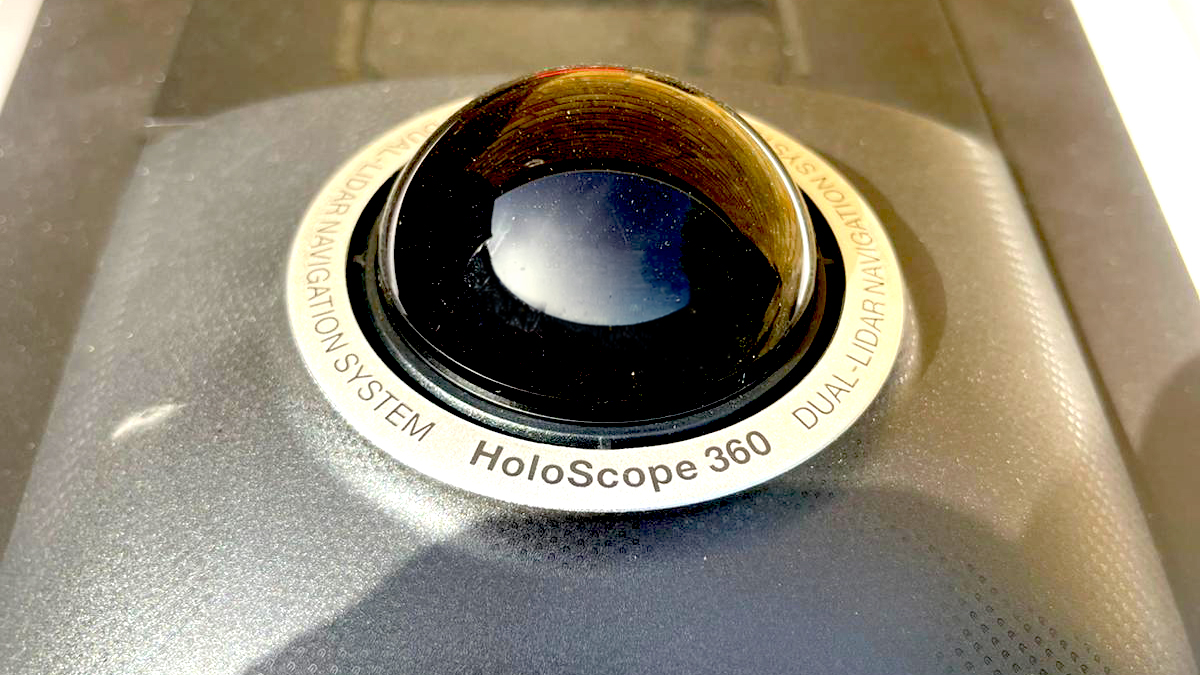
Early implementations used a spinning dome to sweep the laser through 360 degrees, the same design many robot vacuums have used for years, but newer solid-state LiDAR units have no moving parts at all, sitting flush in the mower’s body. This helps reduce cost and improve reliability.
LiDAR vs RTK vs boundary wire
Three distinct navigation approaches now compete in this category. Boundary wire is the oldest and simplest: a low-voltage perimeter cable, buried or pinned around the lawn’s edge, that the mower never crosses.
RTK, short for real-time kinematic positioning, uses satellite signals to pinpoint the mower’s location to within a few centimetres, but it needs a relatively clear view of the sky to stay accurate. RTK systems can either require a base station in the garden, or the data can be sent over the internet (cloud RTK), provided your robot has a constant internet connection via Wi-Fi or mobile.

LiDAR skips satellites altogether. As Ecovacs puts it in its own comparison of the two systems, RTK depends on external positioning infrastructure that can lose accuracy under obstruction, while LiDAR’s active laser scanning “remains consistent” because it isn’t reliant on any signal from outside the garden.
Why “wire-free, drop and mow” is the big selling point
The headline pitch of LiDAR is the removal of the traditional setup slog. Tony Ho, vice president of business development at Segway Navimow, framed it bluntly when describing the company’s new i2 LiDAR model: “You won’t need to find somewhere for an RTK station to live; you won’t have to deal with your robot getting lost whenever there’s a tree blocking the satellite signal; and you definitely won’t need to lay any boundary wires.”
Ho even went further, describing LiDAR as functioning almost like a mower’s own sense of landmarks, “like human beings – we look for landmarks, right?” The Segway i2 LiDAR model demonstrates that setup speed clearly, using solid-state LiDAR and vision to map a garden in seconds and letting an owner unbox the mower and start cutting the same afternoon.
As we found in our Ecovacs GOAT O1200 LiDAR Pro review, LiDAR makes set-up incredible fast.
Where LiDAR has a genuine edge
That dead-zone resilience is where LiDAR earns its keep in gardens that give satellite-only systems the most trouble. And, LiDAR can be paired with RTK.
The Mammotion Luba 3 AWD pairs 360-degree LiDAR with network RTK specifically so the mower “keeps moving even when GPS reception drops off, rather like a robot vacuum navigating a tricky room”.
That helps with dense tree canopies that block the sky, narrow walled corridors where satellite signals bounce and confuse standard GPS, and gardens boxed in by tall neighbouring buildings that create a signal-blocking “canyon” effect.
Limitations of LiDAR mowers
LiDAR isn’t a universal upgrade over RTK, and it works better in slightly smaller gardens where the the system can ‘see’ properly. For very large gardens, RTK is still required.
This is because large, open, and largely featureless lawns present their own limitation, since 3D LiDAR mowers still need physical reference points within roughly 75 metres to place themselves accurately. LiDAR alone is also weak at spotting small obstacles, which is why most manufacturers pair it with a camera rather than relying on lasers in isolation.
Which brands and models currently use LiDAR
Segway’s Navimow range, unveiled at CES 2026, spans several tiers, from the compact i2 series with its solid-state LiDAR for small and mid-sized gardens up to the flagship X4 and the complex-layout-focused H2, all built on what the company calls multi-modal navigation that blends network RTK, visual SLAM and, on selected models, solid-state LiDAR.
Mammotion offers the same layered approach through its Luba 3 AWD and Luba mini AWD LiDAR, both combining LiDAR, RTK and dual-camera vision under what it brands “Tri-Fusion” navigation. Ecovacs has brought LiDAR to its GOAT range, Roborock has added it to its X1 and Z1 mowers, and newer entrant Anthbot has built LiDAR into its M5. The common thread across nearly all of them is that LiDAR arrives as one layer of a hybrid system rather than a standalone replacement for RTK or cameras.
Is a LiDAR robot mower worth the extra cost?
The honest answer depends heavily on the garden rather than the brand. Open lawns with a clear view of the sky rarely need LiDAR at all, and a well-specified RTK and vision system will cut them just as reliably for less money. Gardens with dense tree cover, narrow side passages, or tall buildings pressing in from multiple sides are a different story, and that’s precisely where LiDAR is reported to make the biggest practical difference. The wider consensus forming among current owners, reflected across mower forums, is that no single technology wins outright, and that mowers combining RTK, LiDAR and cameras together are proving the most capable across the widest range of real gardens.
Check back for our fresh reviews to find out which lawn mower is best, regardless of technology.
The post What is a LiDAR robot lawn mower? appeared first on The Ambient.