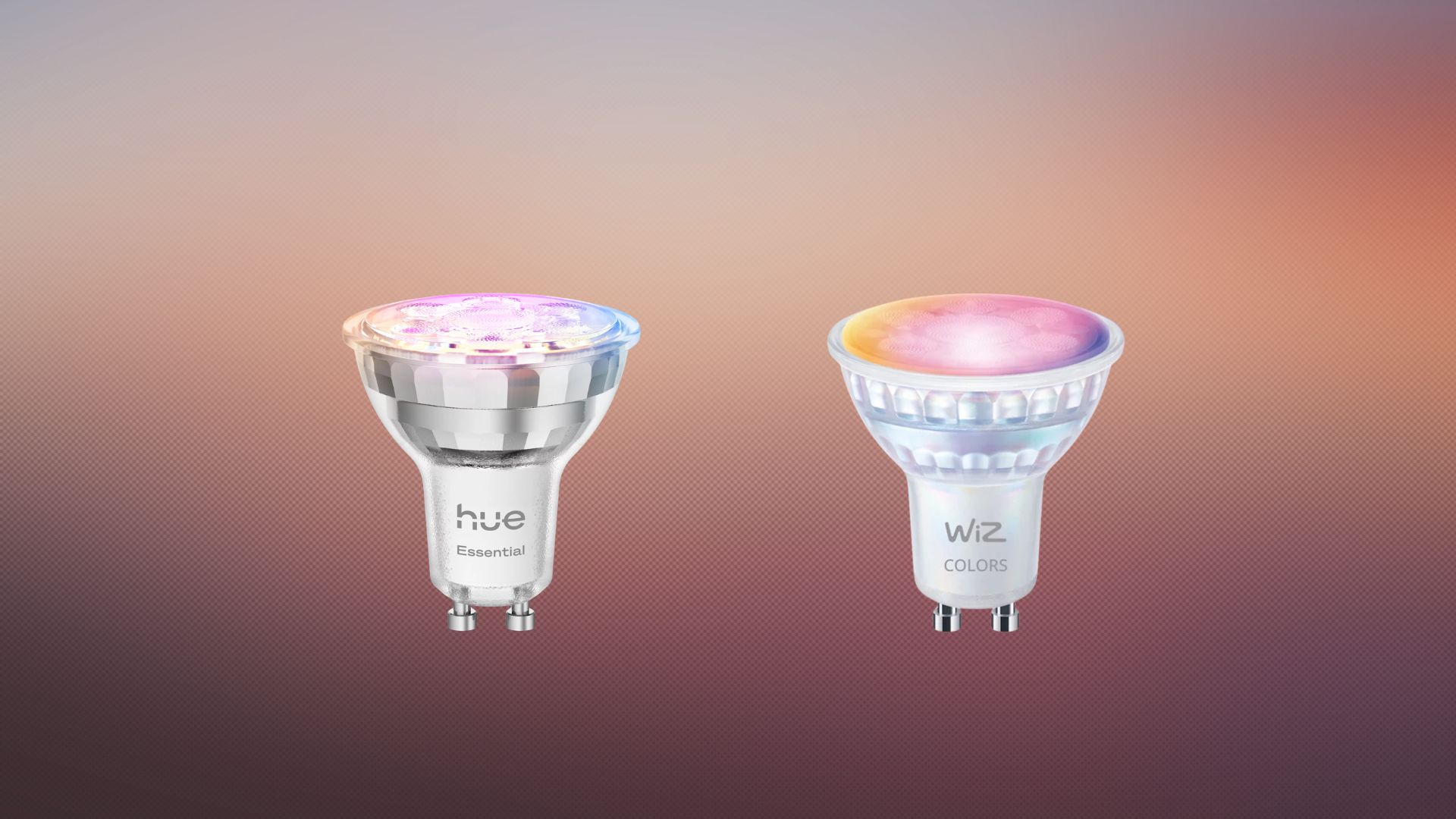
Both Philips Hue and WiZ are made by Signify, yet they sit at opposite ends of the smart lighting market in terms of price, technology, and target audience.
That shared parentage confuses a lot of buyers, and understandably so: if both brands come from the same manufacturer, why does Hue cost two or three times as much per bulb, and what does that premium actually cover?
The answer is that Hue and WiZ are entirely separate ecosystems built on different wireless protocols, running different apps, and designed around different use cases.
They do not share a platform, they do not interoperate without a third-party controller, and choosing between them is less about brand loyalty and more about how seriously you want to invest in smart lighting as a long-term system.
Here we cover which of the two brands leading the charge in the best smart lights race is right for you – using hands-on data from our reviews.
Testing covered a range of bulb types across both systems, including standard A60 and GU10 formats for Hue and equivalent Wi-Fi bulbs for Wiz, all installed across multiple rooms over several weeks.
We evaluated setup experience, app usability, colour accuracy, brightness consistency, and smart home integration across Apple Home, Google Home, and Home Assistant.
Connectivity stability was assessed on both a mesh Wi-Fi network and a single-router setup to reflect the range of home environments readers are likely to be working with.
The price difference between the two systems is more significant than a per-bulb comparison suggests, and it is worth working through the full cost picture before drawing conclusions.
WiZ bulbs sit between £6/$8 for a basic white bulb and £15/$19 for a full color option. Hue’s equivalent bulbs range from £15/$19 to £50/$60, and that’s before accounting for the Bridge – the hub required to unlock remote access and automations – which adds around £59/$60 to the cost of entry.
That upfront Bridge cost is what widens the price gap between the two – making it much more than a per-bulb comparison suggests.
If you’re looking for value, WiZ offers that and more. Hue justifies its cost at scale, especially since the Zigbee mesh becomes more stable the more bulbs are added and the new Bridge Pro (launched 2025) removes the 50-bulb ceiling for large installs. If you’re fitting out your entire house, Hue wins. If you’re looking to improve one or two rooms, WiZ is the obvious answer.
Hue carries a substantially larger product catalogue, spanning standard bulbs, light strips, outdoor fixtures, gradient lighting, and specialist formats.
The Philips Hue Neon Outdoor Strip Light sits among the more refined outdoor smart lighting products currently available, and the range extends from basic white ambience bulbs through to full RGBW color options across a wide variety of fixture types. Hardware design is consistent and well-finished across the line.
WiZ has expanded its range steadily and now covers most of the same categories, including color bulbs, white bulbs, lightstrips, and an HDMI Sync Box for TV backlighting, though you do have less choice generally.
Build quality is functional rather than premium, which is appropriate given the price positioning, and the bulbs are visually indistinguishable from standard smart bulbs once installed.
For anyone fitting out a complex space with varied fixture types, Hue’s depth of range gives it a clear advantage. For straightforward room-by-room lighting with standard sockets, WiZ covers the necessary ground without issue.
This is the most technically significant difference between the two systems. Hue runs on Zigbee, a low-power mesh protocol that operates independently of home Wi-Fi via the Bridge.
Every bulb acts as a node in that mesh, meaning the network becomes more stable as more devices are added. Response times are low, reliability is high, and the router’s device count remains unaffected regardless of how many Hue bulbs are installed.
WiZ connects each bulb directly to a home’s 2.4GHz Wi-Fi network. The absence of a hub lowers the barrier to entry and removes an upfront cost, but it means every bulb is an additional device on the router.
In a home that already runs 30 or 40 connected devices, adding 10 WiZ bulbs takes that count higher, and on budget routers or congested networks that can translate to dropouts, slower response times, and occasional connectivity failures. On a quality mesh Wi-Fi setup the impact is considerably less pronounced, but it remains a variable worth factoring in before committing to the system at scale.
On capacity, WiZ can theoretically support as many bulbs as the router allows, often upwards of 250, which makes it appealing for large installs on paper. The standard Hue Bridge caps at 50 bulbs, though the new Hue Bridge Pro, expands that ceiling for users who need it.
Both apps are functional, but they serve different audiences and reflect different philosophies about what smart lighting should require of the person using it. The Hue app is the more fully featured of the two, with a wider range of automation options, scene creation tools, and integration with Hue Sync for entertainment lighting.
The depth of options has historically drawn criticism for complexity, and that critique has some validity – casual users may find the menu structure more demanding than necessary.
The WiZ app is simpler, more approachable, and quicker to produce useful results from out of the box. Schedules, scenes, and basic automation are straightforward to configure, and the app has improved considerably over the past two years. WiZ’s circadian rhythm mode, which adjusts color temperature across the day in line with natural light patterns, works reliably and requires no configuration beyond activation.
Hue’s equivalent Natural Light feature performs a similar function with comparable effectiveness, though it sits deeper within the app’s menu structure.
On entertainment sync, Hue Sync is the more capable system overall, reacting to music, games, and video content with a level of ecosystem integration that the WiZ HDMI Sync Box does not match in depth, despite being a capable standalone product in its own right.
WiZ performs better here than its price might lead buyers to expect. WiZ bulbs generally score higher on Color Rendering Index than Hue’s quoted figure of approximately 70 CRI, which means room colors appear more accurate and natural under WiZ light in practical use. In direct comparisons, WiZ bulbs are best for vibrancy and for dimming behaviour at low intensity levels, while some Hue bulbs can produce a slightly cool cast.
Hue bulbs are generally brighter at peak output and offer strong consistency across the range, which is relevant when mixing bulb types across a large space where uniformity matters. The gradient lighting products in the Hue range, including the lightstrips and the Play bars, produce more sophisticated multi-color effects than anything currently available in the WiZ catalogue.
For everyday white and color lighting in standard rooms, WiZ is the stronger value proposition on color quality. For premium consistency across a large or varied installation, Hue’s output control is more precise.
Both systems now support Matter, the cross-platform standard that allows devices to function across Apple Home, Google Home, Amazon Alexa, and Home Assistant without manufacturer lock-in. WiZ adopted Matter earlier than Hue, which gave it an initial advantage among technically engaged users building mixed ecosystems, but Hue has since reached parity and both brands offer comparable Matter functionality in practice.
One question that surfaces regularly among buyers is whether Hue and WiZ can be used together. The direct answer is that they are not natively interoperable: the two systems do not communicate with each other without a Matter controller acting as an intermediary.
Anyone who already owns one system and is considering adding the other will need a compatible Matter hub to manage both from a single interface.
WiZ is the more practical choice for buyers who want capable smart lighting without the cost or complexity of a hub-based system. Setup is fast, the app is accessible, color quality outperforms the price point, and Matter support means it integrates with whatever platform is already in use.
For a first smart lighting install, a rental property, or any space where the investment ceiling is modest, WiZ is the more sensible starting point.
Hue is the stronger system for buyers who want the most capable smart lighting available and are prepared to absorb the cost that comes with it. The Zigbee mesh is more reliable than per-bulb Wi-Fi in complex home environments, the product range is broader and more varied, the entertainment sync features are more developed, and the ecosystem has a consistency and maturity that WiZ has not yet reached. The Bridge Pro addresses the capacity ceiling that previously limited large installs.
The total cost is considerably higher, but for a permanent home where lighting forms part of a wider smart home investment, Hue’s premium is grounded in genuine technical difference.
For broader alternatives beyond these two brands, our best smart lights guide covers the wider market including options from Govee and others.