The WaveShare ESP32-C5 development board has generated interest for its potential in IoT applications, prototyping and maker projects. With features like dual-band Wi-Fi, Matter protocol support and an integrated suite of sensors, it offers a robust platform for a variety of use cases. However, as Valleytech Custom Solutions highlights, its reliance on beta firmware and the absence of a protective casing introduce some practical challenges. For instance, users may need to invest additional time in firmware troubleshooting or create custom enclosures for real-world deployments, which could influence its appeal for certain projects.
In this guide, you’ll explore how the ESP32-C5 performs in key areas such as memory capacity, connectivity options and sensor integration. Gain insight into its suitability for IoT projects, smart home automation and prototyping, while also understanding the trade-offs involved, like limited USB-C connectivity and enclosure requirements. Whether you’re a professional developer or a hobbyist, this breakdown will help you assess whether the ESP32-C5 aligns with your project needs.
WaveShare ESP32-C5 Key Features and Specifications
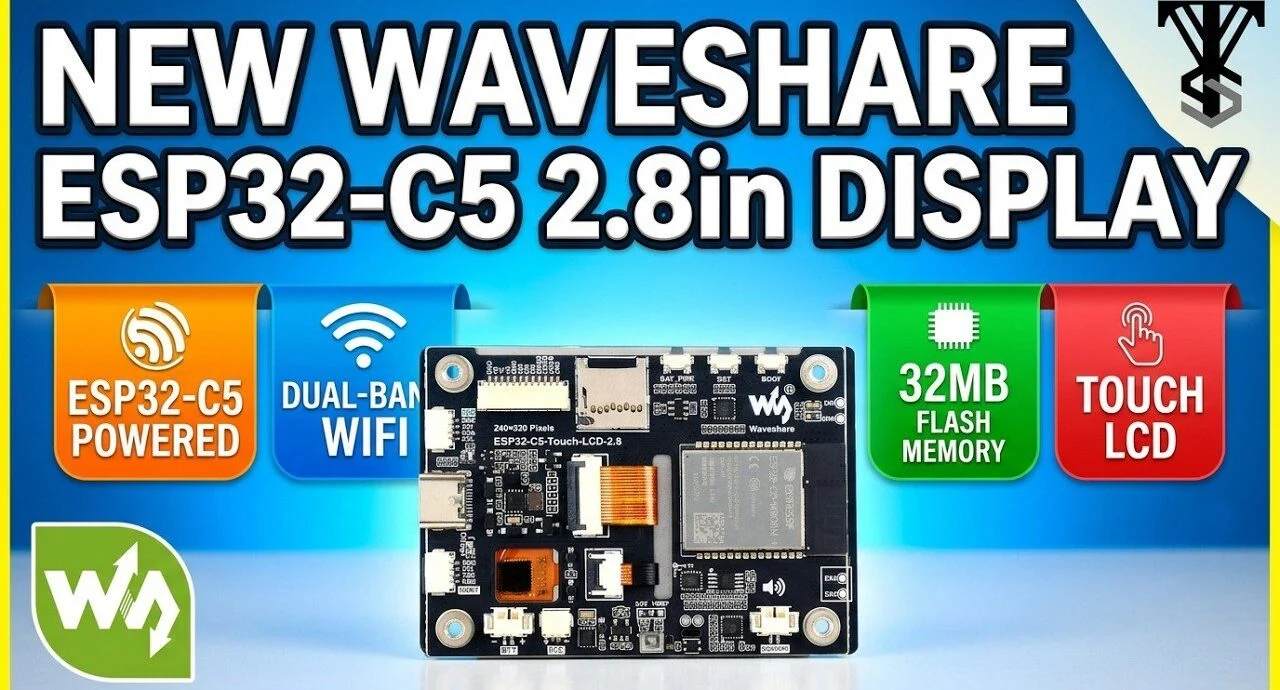
- The WaveShare ESP32-C5 is a compact and versatile development board designed for IoT applications, featuring robust hardware like 32 MB flash memory, dual-band Wi-Fi and advanced sensors.
- Key features include a 240×320 capacitive touch screen, audio support via JST connectors, a real-time clock and expansion options through SPI and Grove connectors.
- Its design emphasizes portability and functionality, with battery support and a USB-C port, though it lacks a protective casing and a second USB-C port for simultaneous debugging and power supply.
- Applications range from IoT projects and smart home devices to weather stations and AI assistants, making it suitable for both professionals and hobbyists.
- Challenges include reliance on beta firmware, the need for a custom enclosure and limited connectivity options, but it holds significant potential as firmware and community support improve.
The ESP32-C5 distinguishes itself in the IoT development space with its robust hardware and versatile capabilities. Its specifications cater to a wide range of applications, making it a valuable tool for both professionals and hobbyists. Key features include:
- Memory: Equipped with 32 MB flash memory (with a 16 MB variant for budget-conscious users) and 8 MB PS RAM, it handles complex tasks with ease.
- Connectivity: Dual-band Wi-Fi with support for Matter, Zigbee and Thread protocols ensures reliable and flexible communication.
- Display: A 240×320 capacitive touch screen powered by the ST77 driver enhances user interaction.
- Sensors: Built-in temperature, humidity, acceleration and gyroscopic sensors expand its functionality for diverse applications.
- Audio Support: Microphone and speaker connectivity via JST connectors enable audio-based projects.
- Real-Time Clock: Essential for time-sensitive applications, making sure precise scheduling and synchronization.
- Expansion Options: SPI bus with Grove connectors for UART and I²C communication provides flexibility for additional modules.
These features position the ESP32-C5 as a versatile platform capable of supporting applications ranging from environmental monitoring to smart home automation.
Design and Build Quality
The ESP32-C5 is thoughtfully designed to balance practicality and portability. Its compact layout optimizes space, while its sturdy construction ensures durability. Key design elements include:
- Battery Support: Compatible with a 1,000 mAh battery via DuPont to JST cables, making it ideal for portable and remote applications.
- USB-C Port: Simplifies power and data connectivity, though the absence of a second USB-C port, common in some competing models, limits simultaneous debugging and power supply options.
While the board’s design is functional, it lacks a protective casing, which may necessitate the use of a 3D-printed or custom enclosure for real-world deployments. This additional requirement could be a minor inconvenience for users prioritizing out-of-the-box usability.

Check out more relevant guides from our extensive collection on ESP32 that you might find useful.
How It Compares to CYD Models
When compared to the C5 CYD model, the WaveShare ESP32-C5 offers several notable advantages that enhance its appeal for IoT and prototyping tasks:
- Memory Capacity: The ESP32-C5 doubles the flash memory, accommodating more demanding applications.
- Enhanced Sensors: Additional built-in sensors provide greater functionality for diverse projects.
- Connectivity Options: Dual-band Wi-Fi support ensures reliable and flexible communication across various protocols.
Both models are similarly priced, ranging from $20 to $25. However, the C5 CYD includes two USB-C ports, which may be advantageous for users requiring more flexible connectivity. Despite this, the ESP32-C5 delivers better overall value for most IoT scenarios, particularly for projects that benefit from its advanced sensor suite and robust memory.
Applications and Use Cases
The ESP32-C5 is a versatile development board suitable for a wide range of applications. Its feature set makes it an excellent choice for developers and hobbyists exploring innovative projects. Potential use cases include:
- IoT Projects: Its reliable connectivity and sensor integration make it ideal for IoT applications such as remote monitoring and control systems.
- Smart Home Devices: Perfect for environmental monitors, automation controllers and other home automation tools.
- Prototyping: A valuable platform for developers experimenting with new ideas and technologies.
- Weather Stations: Use the built-in temperature and humidity sensors to create compact weather monitoring systems.
- AI Assistants: Use its microphone and speaker support to develop voice-enabled assistants or interactive devices.
Its flexibility and comprehensive feature set make it a compelling option for a variety of innovative projects, catering to both professional developers and hobbyists.
Limitations and Challenges
Despite its impressive capabilities, the ESP32-C5 has a few limitations that may affect its usability for certain users. These include:
- Firmware Support: The board currently relies on beta firmware, which may require additional time and effort for custom development or troubleshooting.
- Enclosure Requirement: The lack of a protective casing necessitates a 3D-printed or custom enclosure for practical deployment, adding an extra step for users.
- Connectivity Trade-Off: The absence of a second USB-C port limits simultaneous debugging and power supply options, which could be a drawback for some developers.
These challenges make the ESP32-C5 less suitable for users seeking a plug-and-play solution. However, for those willing to invest time in customization and development, it offers significant potential for advanced applications.
Future Potential
The WaveShare ESP32-C5 holds considerable promise as firmware support matures and the developer community expands. Its advanced specifications and competitive pricing position it as a valuable tool for IoT development. Over time, it is expected to become a go-to solution for:
- Smart home devices and automation systems.
- Environmental monitoring and data collection platforms.
- Prototyping emerging technologies and innovative applications.
As the ecosystem around the ESP32-C5 evolves, its usability and functionality are likely to improve, making it an even more compelling option for developers seeking a versatile and cost-effective development board.
Media Credit: Valleytech Custom Solutions
Disclosure: Some of our articles include affiliate links. If you buy something through one of these links, techschimp Gadgets may earn an affiliate commission. Learn about our Disclosure Policy.